


3.1 Guiding and teaching
Discussions about guiding and teaching may conjure images of formal instruction in classrooms – teachers in front of classes, “telling” students what they want them to know. However, guiding and teaching is a much broader concept. We can think of this as “steering” children in a certain direction. For very young children, this might mean supporting them to wait a little longer to have a turn or providing them with opportunities to investigate something they are curious about. Watch the next video to see two children involved in a very common daily routine – hand washing.

What do the adults say and do to guide and teach these children?
What are the children learning?
Our approach to guiding and teaching is greatly influenced by our view of children. If we believe children to be capable, competent and naturally curious we will respond to them in positive ways that support their development, and create environments for them to thrive. Listen as Dr. Jean Clinton, clinical professor of Psychiatry and Behavioural Neuroscience at McMaster University, explains the importance of caregivers examining their view of children and then on the need to pay attention to the relationship between the adult and child.
In the next video, Greta is intensely curious about a new baby. Watch as her mother guides her interest, encourages and monitors Greta to be gentle, and models language development.

How does Greta’s mother respect Greta’s interest in the baby?
What do you think might have happened if Greta’s mother told Greta to leave the baby alone?
Play-based learning
In the Coping and Competence module you learned about the value of play by focusing on imaginative, active, outdoor, and risky types of play. The adult role of play was also explored.
Read about “Play with Purpose” to further explore the importance of play. The following chapter summary, part of The Early Years Study 4 (McCain, 2020) is an excellent discussion of key information on this topic. Various benefits of play are reviewed, including an overview of the various skills children can enhance through play. Note the continuum of play – think about how this relates to your program/experiences.
What is meant by “play with purpose”?
What are your thoughts about the range of educator and child led activities that make up the Continuum of Play Approach?
Think about a typical day in your early childhood program. Which types of play do you observe? Can you think of examples of each of the 5 types of play? Which types of activities do you facilitate or promote?
Traditional educational approaches emphasize the basics and learning solid skills through structured direct adult instruction. Less traditional and more progressive approaches focus on understanding, problem-based learning and projects rather than on specific skills and knowledge. Listen now as Dr. Janette Pelletier, professor emerita of Applied Psychology and Human Development at the University of Toronto, describes play-based programs and how educators can take advantage of children’s need to play.
In the next clip, watch as children play – and learn – together.

The next reading from the Canadian Child Care Federation looks at how play and learning are linked and briefly describes how to implement this play-based approach in early childhood settings.
Educators can take advantage of learning opportunities that emerge AND they can structure learning opportunities into a child’s day. Educators can guide learning experiences that are within children’s zone of proximal development. The zone of proximal development is a concept developed by Lev Vygotsky. It refers to the difference between what an individual can do on his/her own and that which s/he can do with help or support from an adult or peer who is more capable.
Consider…
Three-year-old Ted is in the block area trying to build a tower with small blocks. He places four small red square blocks on top of one another and then puts a large blue rectangular block on top…Read more
What can Ted do with the blocks, without Carl’s help?
What is Ted learning with Carl’s guidance?
When educators scaffold children’s learning, they support the children through the problem-solving process, encouraging them to try something new, persist and find alternative solutions. The educator challenges children to use their observations to predict and draw conclusions, to think about how things work, to think about why something happened and then encourages children to reflect on what they could do differently or change the next time.
In the following video you will see a young boy experimenting with balance and weights.
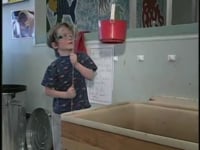
How did the physical environment and the early childhood educator encourage exploration?
What do you think the young boy was experiencing in this play?
If you were the early childhood educator, what might you do next, if anything?
Educators in effective early childhood programs regularly engage in adult-child interactions that challenge, encourage joint attention and negotiate sustained shared thinking. Did you see examples of these types of interactions in this exchange?
Listen now as Dr. Joan Durrant, child-clinical psychologist and professor emerita of Community Health Sciences at the University of Manitoba, and Executive Director of Positive Discipline in Everyday Life (PDEL) of Family Social Sciences at the University of Manitoba, explains the concept of scaffolding.
Can you think of a skill you have acquired through scaffolded learning?
What would you identify as key qualities in an adult who is trying to support scaffolded learning for children?
Supporting emerging literacy
The next videos discuss and show wonderful ways to support children’s language and literacy abilities. In the first video, Dr. Michael Yellow Bird, Dean of the Faculty of Social Work at the University of Manitoba, explains the value of storytelling for brain plasticity. The second video is part of the video series Our Children Our Ways: Early Childhood Education in First Nations and Inuit Communities. The third video was filmed in Madrasa preschool programs in East Africa. The wonder of hearing stories, the stimulating environments, the active learning materials and the encouraging teachers provide many different opportunities to support language and literacy skills.



As you watch children involved in language and literacy activities in different parts of the world, what are the various strategies that you noticed educators using to engage children? Why do you think these are important?
The resource sheet below, from the Canadian Child Care Federation, has easy-to-implement suggestions for creating an environment and play opportunities that support language development.
Supporting emerging numeracy
Children develop mathematical understanding through a combination of repeated experiences with materials and normal developmental growth. The following resource sheet from the Canadian Child Care Federation has a variety of simple activities and experiences that support numeracy development.
Preschools and primary schools can build on children’s informal, everyday math to develop the concepts, procedures and symbolism of mathematics. An environment rich with objects and materials is a starting point, but what is most important is what children do with them. Consider these play areas below. The one on the left was taken in a North American preschool and the one on the right is from Kenya.


In what ways are the materials in each photo similar and different?
What mathematical concepts can children explore while using these materials?
Natural items in our environments provide interesting play materials for children to explore. Consider the following natural and recycled materials and the potential for fostering numeracy skills (click for full-sized images).


In the next video, observe how children in East Africa are building mathematical understanding by playing with simple materials.

What is meant by the “language of math” for young children? What are some examples?
What mathematical concepts can children explore with these materials?
- twigs of various lengths
- a variety of buttons
- cardboard boxes of various sizes
Researchers have found that many local games and songs support children’s informal understanding of mathematics. The next reading describes two children’s games that involve mathematical understanding: Nhodo, a numbers game played in Zimbabwe and Mancala, a game dating back thousands of years and played in different versions around the world. Note that both games are more likely to be played by children ages six or seven and up, an age when many children are very fond of games with rules.
How do you think these games support mathematical understanding?
What games did you play as a child that involved math?
Similarly, think of all the everyday regular routines and interactions that can offer many opportunities to explore mathematical concepts. For example, counting “1 and 2” when putting on shoes to go outside, watching a plant grow from little to big, and noticing the shapes of toys and natural materials.
The readings and videos above focus on the benefits of exposing children to math concepts during daily tasks using everyday items that are easily available and provide active learning opportunities. As you look at the photos in the following slideshow, consider how each play environment might allow a child to explore math concepts.


