


1.2 Thinking and learning

Young children are very curious! They seem to be born with an eagerness to learn about the world around them. Adults often refer to children as “sponges” to highlight the way children seem to soak up experiences and knowledge in what appears to be an effortless way.
In early childhood especially, learning is intricately connected with other aspects of development. For example, how we learn to control our emotions is linked to how we learn to pay attention and problem-solve. As well, the same patterns of development happen in different areas of learning.
Read about a discussion of the patterns of development across domains.
Think of the young children you know. How are they demonstrating these patterns of development?
Why must we be careful in “applying” universal milestones when thinking about early human development?
The next clip contains examples of children’s thinking and learning, filmed in East Africa. What do you see that shows that the children are thinking and learning? What do you see in the environments that might be supporting their thinking and learning?

Learning though play
Children learn in many ways, but in the early years they mostly learn informally, through play and other daily activities. Children all over the world seem to naturally play, whether adults are involved or not.
The following article from the Canadian Council on Learning provides a comprehensive overview of play and learning in early childhood.
Play optimizes brain development, promotes physical growth, and fosters social and emotional development. Young children come to understand their world, navigate their surroundings and learn to negotiate with others. Children develop a repertoire of flexible responses to situations they create and encounter, develop self-regulation and learn to overcome day-to-day challenges.
Listen now as Dr. Bryan Kolb, professor at the Canadian Centre for Behavioural Neuroscience at the University of Lethbridge, explains why and how play is essential for brain development.
Think about your own childhood memories of play. What was your favourite play activity and why? What do you think you were learning in this play?
The following review highlights some of the key ways that adults can support children’s learning through play.
Literacy and numeracy
Literacy is the ability to use language in all its forms of communication: listening, talking, reading, writing, music, dance, story-telling, visual arts, drama and digital media.
Everyday life experiences – speaking, listening, reading, watching, drawing and writing – are part of early literacy. Young children gradually understand that what is said can be written. For most children, learning to print their name is one of the first activities in learning to print words. In the next clip, watch as Evan practices printing his own name and works hard to get the letters correct.

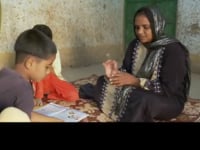
Watch this video, filmed in a rural Egyptian home, to see a mother’s involvement with her two boys as they do their homework before going out for some fun. Note the ways the mother supports her children’s reading skills and their understanding of what they have read.
Young children develop informal mathematical understanding through everyday experiences in the world and this comes before numeracy development.
Numeracy is a particular aspect of thinking and learning that is described by the ability to work with mathematical concepts and reason with numbers. Mathematical concepts include things like number relations (quality and quantity), measurements, calculation skills, geometry, patterns, probability and statistics. Numeracy skills are just as important as literacy skills.
The development of language and learning in the early years provides an important foundation for further development. In the next section, examples of research related to early language learning, literacy and numeracy offer further insight into the capabilities of young children. As well, the role of adults in fostering children’s development and learning is emphasized.


