


2.3 Early mathematics
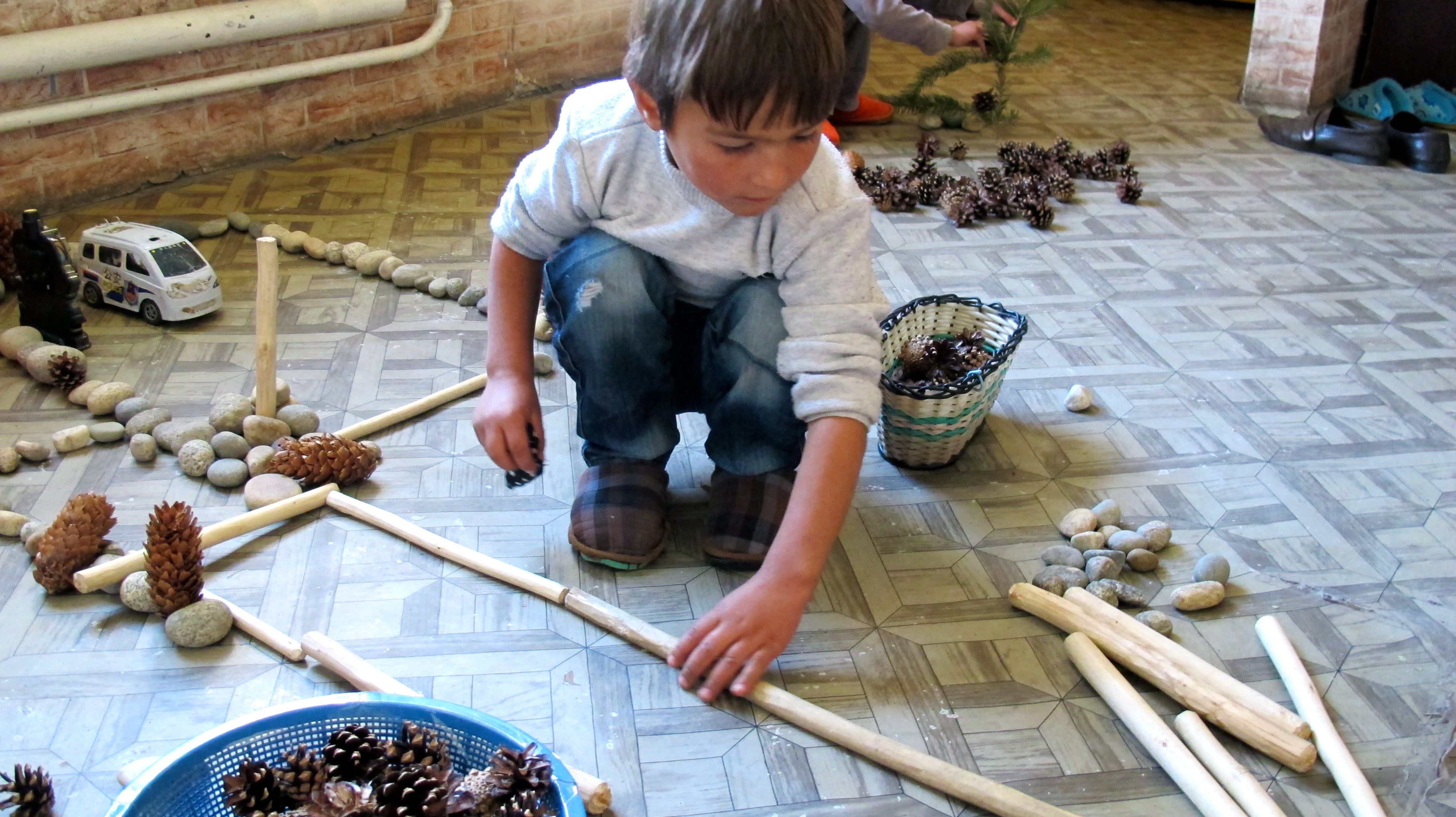
Children develop early mathematical understanding when they have experiences that support their understanding of number concepts. For example, during play and everyday experiences children can count, discuss and compare quantities and qualities (more, less, same, different), measure objects, order and classify and investigate patterns.
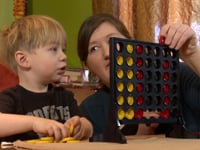
In the next video, as a mother and son play a simple game together, she incorporates some concepts and words related to mathematics. As you watch, consider all the ways she supports his development.
What is the progression of children’s understanding of numbers and mathematics during the early years? See the following for a summary.
Infants can notice the difference between two collections varying in numbers and locate objects in space. Often a quantity word, such as “more”, is a baby’s first word.
From age 2 or so, children often begin to learn the language and grammar of counting. They memorize the first 10 or so counting words as nonsense words with no underlying meaning. They then begin to understand that ‘one’ means one apple while three means more than one and also more than two, gradually building a true understanding of numbers. Later, children pick up a set of rules to generate higher numbers.
Between ages 2 and 5 children become increasingly aware of their own thinking about numbers and begin to express it in words. Preschool children are capable of big ideas about numbers and operations, geometry (or shape and space), measurements and patterns (or algebra).
Understanding shape means analyzing and constructing shapes and defining their features. Children begin to be able to sort and also build shapes and gradually can verbally explain the differences between and square, i.e., a triangle and a circle.
Understanding numbers involves reasoning about them, making inferences and developing a mental number line, with smaller numbers on the left and spaced further apart than larger numbers on the right. This helps children hold numbers in their mind and manipulate numbers in arithmetic problems as they begin school.
In the next video, Dr. Joanne LeFevre, director of the Institute of Cognitive Science at Carleton University, describes how children learn to count, explaining the difference between verbal or rote counting and the more complex counting of objects. In the second video, LeFevre explains how children learn how those quantities map onto written symbols.
How would you explain the difference between verbal (or rote) counting and counting objects?
What knowledge do children need, and what strategies do they use, when learning to meaningfully count objects?
Four categories of mathematical concepts preschool-aged children can understand are described in the next reading, along with examples of each.
Can you think of other real life examples of child behaviours that illustrate these four types of mathematical knowledge?
Daily environments and experiences with frequent references to quantity and quality relationships and the use of numbers nurture stronger mathematical understanding. Children are capable of learning more and deeper mathematics than educators often assume they can.
Memorization or informal mathematical knowledge alone will not lead to full mathematical
understanding. For example, it is relatively easy for many children to learn to count by rote, but it doesn’t necessarily mean they understand the meaning of numbers.
Preschool and primary-school-aged children benefit from teaching that focuses on helping children discover patterns and relations (Baroody, 2006). Consider the materials in these two pictures and how they can be used to explore patterns and numeracy concepts.

Researchers agree that concrete materials are extremely useful in aiding children’s understanding of mathematical concepts. As David Elkind (2003) writes, “it is hard to overemphasize the importance of these hands-on experiences for young children… It is certainly important for children to learn number words, but it is even more important that they learn to classify and seriate real objects” (p. 41).
The following resource sheet is from the Canadian Child Care Federation. It provides an overview of the many numeracy abilities that children typically show from birth through age six.
Based on the listing of numeracy abilities in this reading, what ideas do you have for activities or materials to provide for young children?
Everyday experiences offer many opportunities for young children to explore and develop early mathematical understanding. Numeracy is learned through the interactions with adults that foster numerical understanding as well as the materials available for children to manipulate. Try the following game to review information you have explored on this page.
The game on the next page reviews key points in the research section (pages 2 to 2.3).
The links to practice section looks at some specific strategies to support children’s early language, literacy and numeracy skills.


