


2.1 Early language development

Did you know that right from the start newborns have language abilities? For most of us, the concept that newborns have language abilities at all is a very new idea.
One of the really interesting aspects of Dr. Janet Werker’s research is her understanding of the complexity of newborns’ language abilities. In the following video, Werker describes how she conducts her research at the University of British Columbia’s Infant Studies Centre.
The language(s) that an infant hears shapes their ability to recognize familiar speech sounds and rhythms of the language(s). Their brain is being shaped to understand and use their native language(s). Werker describes some findings regarding how babies are tuned to the properties of their native language(s) and how this develops in the first year.
Were you aware newborns have the capacities that Werker describes?
What did you find most interesting about this research?
The next video is from the documentary The Beginning of Life. As you watch this clip, consider how the examples of adults listening, singing, reading, and talking support children as they acquire language.

Page 1.1 of this module discusses that adults seem to naturally speak to infants and young children in a way that they prefer. The characteristics of infant- or child-directed speech include things like higher pitch, elongated vowel sounds, and a happy, musical quality. Watch the video that follows to see how researchers study infant language preferences in the Baby Language Lab run by Dr. Melanie Soderstrom at the University of Manitoba.
Some American research indicates that one factor that seems to make a big difference in children’s language capacity is how often adults talk with them. Apparently, quantity counts. That is, children who hear more and richer language develop greater vocabularies and, in turn, have a better foundation for literacy. Children who hear less language and fewer words still learn to speak normally but have a more restricted vocabulary and are more likely to have more difficulty learning to read and write.
In the book, Meaningful Differences in the Everyday Experiences of Young American Children, authors Hart and Risley (1995) present fascinating ground breaking findings regarding children and their language development. They conducted a longitudinal study of parents and children (1-3-years of age) in their homes. Families were observed each month for two and a half years and conversations between parent and child were recorded. Their sample included 42 families who were classified as either professional, working class or welfare.
What differences did Hart and Risley (1995) find?
It was not so much the kind of experiences parents in these three groups offered their children, but the amount of these experiences. Their analysis of recorded data showed a large gap between the quantity of language heard in a year by a child in a professional family (11.2 million words) and a child in a working-class family (6.5 million) and a child in a welfare family (3.2 million).
Parents in all three groups engaged in similar necessary communications (e.g., giving directions, managing behavior). It was the “extra talk” beyond that; the language that was more varied and responsive, that differed.
The way that parents talked to their children when they were toddlers was strongly predictive of children’s verbal ability when they were 9-10 years old.

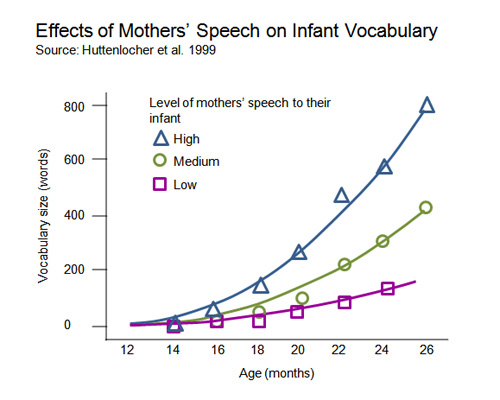
The number of words children hear isn’t just a poverty issue. There are fantastic parents who rear kids in their own bedrooms while living in poverty and actually parent better than some wealthy families. Positive language experience is about parenting” (Clinton, 2020, p. 61).
Dr. Jean Clinton (2020) points out that “…in more recent studies, it wasn’t just being poor that left children with fewer words” (p. 60). Kathy Hirsh-Pasek and her colleagues found that it is not just the number of words children hear, but that the quality of interactions between parents and children also make a difference (Hirsh-Pasek et al., 2015). By watching and analyzing video recordings of mothers and children playing, researchers were able to identify joint engagement and connectedness as particularly important.
A recent research study by Gilkerson et al. (2018) adds further evidence to support the importance of adult’s communication with young children, particularly those 18-24 months of age. The turn-taking interactions of 2 to 36 month-old children and parents were recorded and analyzed using sophisticated technology. Conversational turn-taking was correlated with language and cognitive outcomes measured up to ten years later.
In the next video of a parent and 11-month-old, watch for examples of connectedness, joint engagement and conversational turn-taking.

In the next video, Soderstrom explains how recording studies were done in the past and some technology updates that make it easier to record and process the recordings.
There is no doubt that the Hart and Risley findings were ground-breaking. It is also clear that as research techniques become more refined, researchers continue to study and learn more about children’s language. Listen to Soderstrom for an interesting perspective.
How do you think these findings can be applied to early childhood settings?
How might you use this information when working with parents?
What is the “30 million word gap” and what is the impact on children’s language acquisition? How can parents and caregivers “keep children talking” to help minimize this gap?
Frequency of communication between adults and children is something that can be influenced. Talking with children is an important part of their early experiences, both at home and in early childhood programs. In the next video, watch as the early childhood educator supports a four year old’s language development.

Talking with children also leads the way to early literacy experiences, which is explored on the next page.


