


1.1 Acquiring language
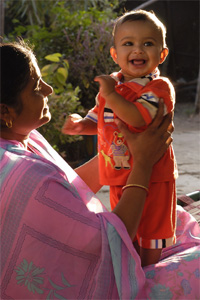
Humans have the unique capacity to create and use language. Other animals can communicate with each other, but their limited numbers of calls or gestures are isolated signals with very specific messages. Human language is flexible and productive – that is, a small number of symbols (sounds or gestures) can be combined according to a set of shared rules to produce an endless number of messages. For example, in the English language, there are only 26 letters (symbols) that are combined to form words that are then combined to form an endless number of messages. It is estimated there are more than 7000 spoken languages in the world today (Eberhard et al., 2020).
Children begin to communicate at birth using sounds and then gestures. Oral language greatly expands the way in which children can express their needs and feelings, exchange ideas and connect with others. Adults around them often observe that as they learn to talk, children become less like babies and more like “little people”.
Humans are prepared to communicate from the moment they are born. Dr. Janet Werker, research chair of the Department of Psychology at the University of British Columbia, explains the remarkable spoken language skills of newborns.
Interestingly, adults seem also to be prepared to speak in a certain way to infants and young children. In the next clip, Werker describes the term motherese and explains that many suggest that it should be called, parentese since mothers are not the only adults who do it. The terms “infant- directed speech” or “child-directed speech” have also been used to describe this unique way of speaking.
Were you aware of the ways that newborns show they are prepared to develop language? Does this have an impact on your view of very young babies?
How do parents in your family, community or culture speak to infants and young children?
Infants are more responsive to higher-pitched voices. Simple, clear pronunciation is easier for children to understand. This makes parentese perfectly suited to their auditory preferences. Adults modify their language interactions based on children’s growing skill and even deaf parents use a form of parentese when signing to their babies (Berk, 2012). Interestingly, adults are largely unaware of adjusting their language when speaking to infants. In the next video, Dr. Melanie Soderstrom, associate professor in the Department of Psychology at the University of Manitoba, discusses the implications of the research on infant- and child-directed speech (see p. 2.1 in this module for a look at how this research is done).
In the Brain Development module you watched Lia talking with her two-month-old baby, Jersey, as an example of a reciprocal or “serve and return” interaction. When you watch the clip again, keep in mind the description of parentese that Werker provided.
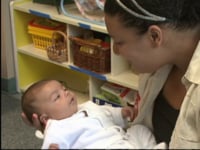
How does the way Lia speak to her baby fit with what you’ve learned about parentese?
What does Jersey do that encourages Lia to keep up the “conversation”?
Watch the next video that shows a beautiful “conversation” between a mother and son.

Now watch as Jakyri, a young toddler, and his father share a banana and have a conversation.

How does each parent support the child’s efforts to communicate?
What does each scene tell you about their relationship?
The next reading reviews typical language abilities of children through the first five years.
Humans are wired to learn language right from the start. Parents and caregivers instinctively change the way they speak to very young babies and research has shown that this aids in learning language. Next, you’ll read about children’s natural eagerness to learn and the role of play in fostering their thinking and learning.


