


2.1 Early regulatory systems
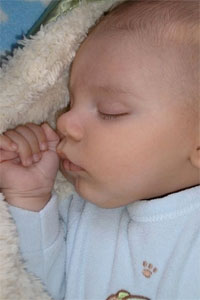
Imagine the shock to newborns after many months in the womb. They now need to quickly adapt to a totally different environment.
There are early regulatory tasks essential to coping to life outside of the womb. In the first few months the close interactions between mother and infant – which include touch, temperature, sounds, smells and movement – have an impact on regulating the infant’s bodily systems and behaviours (Hofer, 2010). Consider how being held close and warm and hearing a familiar voice would offer a safe and comforting experience for an infant and contribute to their developing regulatory systems.
In the early days and months after birth, human infants master a number of tasks:
- maintaining their body temperature;
- organizing their body’s reactions to external stimulation;
- adjusting their awake and sleep cycles; and
- signalling their needs to important adults and beginning to soothe themselves.
Caregiving practices, including how best to respond to a crying baby, sleep routines and feeding practices, vary across cultures. Read about this variety and specifically caregiving practices based on closeness versus separation strategies.
- What are some factors in our society that support a “separation” strategy? Do you see examples that this is changing?
- What are some of the benefits and drawbacks of each approach to caregiving – separation or closeness/attachment for either the infant or adult?
- What advice would you give parents about how much to hold their babies and how promptly to respond to an infant’s distress?
- Think about your own upbringing – how were you raised? Was it more towards a separation approach or more toward closeness?
Crying
Consider…
It is two o’clock in the morning in a downtown high-rise apartment, and four-month old Julien is beginning to stir from a deep sleep. At first, Julien’s cry is intermittent and quiet, but after ten minutes Julien is fully awake and screaming… Read more
This is a common situation for many parents. What do you think about how Julien’s parents responded?
What advice have you heard about responding to a crying baby? Do you agree or disagree and why?
How do you relate this to what you have learned so far about coping and competence?
When babies cry, they are signalling to their caregivers that they need something. At birth, or shortly after, infants typically have four distinct types of cries: the birth cry, the pain cry, the hunger cry and the pleasure cry (Lamb & Lewis, 2011). The birth cry occurs only at birth and is how the infant clears out amniotic fluid from the lungs and trachea. The other cries are often signals to caregivers and may be difficult to distinguish. Unlike other species, human babies may cry for no apparent reason.
In the next clip, Dr. Ron Barr, professor emeritus in the Faculty of Medicine at the University of British Columbia, discusses why some babies cry much more than others.
The news that babies who cry a lot may have stronger survival capacity may be a comfort to parents of babies who cry a great deal, but nonetheless, it is very difficult for parents and others to listen to babies cry. In the next video, Barr describes the term PURPLE crying, in which PURPLE is an acronym for the characteristics of crying sometimes seen in the first weeks and months of a baby’s life. Explore the website that follows for more information, including how the term “colic”, sometimes used to describe excessive crying, tends not to be helpful for adults caring for an infant who cries a lot.
Whether a baby displays some or all of the characteristics of PURPLE crying or not, most caregivers struggle with how to stop a baby’s crying. Dr. Joan Durrant explains that responding to crying helps babies feel safe and secure.
The following reading from Abilio discusses babies’ crying. Abilio is formerly known as the Centre of Excellence for Early Childhood Development (CEECD) and the Centre de Psycho-Éducation du Québec (CPEQ).
Do the comments of Barr and Durrant, as well as the reading, alter your understanding of crying in infancy? If so, how?
Sleeping
Newborns tend to sleep a lot, usually in many different segments throughout the day and night. Early sleep regulation is one of the first tasks for a newborn.
The Sleeping behavior: Synthesis in the Encyclopedia on Early Childhood Development (December 2020) discusses sleeping research and makes these key points:
- Undesirable sleep behaviours, such as disrupted, not enough and poor-quality sleep, are actually quite common and affect 20% – 30% of preschool children. However, in most cases, these problems are temporary.
- Healthy sleep habits are crucial. If poor or insufficient sleep behaviours persist it may affect a child’s development in a variety of areas i.e. cognitive, behavioural, emotional and physical development.
- A child’s sleep problems are very stressful on the parents as it can also affect the amount of sleep they are able to get themselves. Overtired parents may demonstrate less patience and energy during the day and this in turn may influence the parent-child relationship.
- The maturation of the brain (the central nervous system) is related to infant’s sleep development.
- Both the child’s biology as well as their environment can influence sleep problems. For example, neurological problems may contribute to problem sleep behaviours. On the other hand, parenting practices such as always holding and rocking an infant to sleep limits the opportunities for an infant to learn to fall asleep on their own. When waking during the night the infant may not be able to soothe herself or himself and therefore not fall back to sleep without being held and rocked.
Getting enough sleep promotes healthy growth and development. While the amount of sleep children need varies with age and individual there are some general guidelines regarding the amount of sleep children need and how to promote healthy sleep habits. The following webpage from the Canadian Paediatric Society is a helpful resource for caregivers interested in promoting healthy sleep habits for young children.
The article emphasizes the importance of establishing a bedtime routine for children. Why is this important?
Executive function

Self-regulation develops and matures from preschool through adolescence with a suite of interrelated skills known as executive functions. Mastery of executive function skills help us regulate our emotions, behaviour and attention and ultimately reach our goals.
Dr. Philip Zelazo, a developmental psychologist and neuroscientist from the University of Minnesota, describes what is meant by the term executive functions, and how it relates to self-regulation.
Executive function includes the ability to:
– stay on task, inhibit impulsive actions and pay attention (inhibitory control);
– hold information in mind and recall it for use later (working memory); and
– change plans and try different strategies to find solutions (mental flexibility).
Consider…
When four-year-old Malik arrives in his preschool, he finds a spot and sits next to his friends on the mat. The teacher greets everyone and the children sing together…
Read more
What kind of regulatory skills do you see Malik demonstrating?
How do these skills help Malik adjust to school – socially and in terms of learning?
How might Malik behave differently if he didn’t have these skills?
Differences in executive functions explain why some children seem much more ready for school – to listen, to show some independence, to be able to complete a task – than others.
In the following clip, Zelazo explains that executive functions are key developmental outcomes.
Executive function can easily be observed in many daily tasks and interactions in children’s daily lives. As you watch the next video, consider the child’s ability to stay on task and the various ways his attention is being challenged.

As you observed the child building the tower, what did you notice about his ability to inhibit impulsive actions and pay attention? What did he do to stay on task?
What did you notice about his ability to change plans and try different strategies to find solutions? How did he modify his plans when the structures fell down?
Early regulatory tasks establish the foundation for eventually being able to manage powerful emotions, pay attention and get along with others. Interactions between children and their parents and caregivers influences children’s emerging regulatory abilities, including self-regulation. Next, you will explore more about parenting practices and the influence on children’s development.


