


1.1 Self-regulation

Self-regulation is “…an ability to be boss of one’s own attention, emotion and behaviour at an appropriate level for one’s age and culture” (Clinton, 2020, p. 51). This involves taking into account our own thoughts and feelings and those of others as well. Self-regulation is central to our transition from helplessness to competence.
Dr. Stuart Shanker is a distinguished research professor emeritus at York University. In the next video, he describes what is meant by the term self-regulation and how it is closely connected to early brain development. He explains how adults act like an “external brain” that guides children’s behaviours before they learn to regulate themselves.
Although they are related, self-regulation is not the same as self-control. Listen now as Jean Clinton, clinical professor of Psychiatry and Behavioural Neuroscience at McMaster University, explains.
Dr. Carl Corter is a professor emeritus at the Ontario Institute for Studies in Education, University of Toronto. He explains how self-regulation is a set of self-management skills that begin to develop early and continue throughout life. Note how he mentions that self-regulation is not just self-control (restraining behavior), but can also involve actively doing things.
Corter discusses how a young child’s experiences influence the development of self-regulation and how that can have long-term effects on their lives.
As Shanker and Corter point out, children learn self-regulation by being regulated. The next video shows examples of caregivers helping infants and young children develop self-regulation – in other words, co-regulating. Notice how the caregivers act as “external brains” and provide just enough support so that the children can regulate their own behaviour.

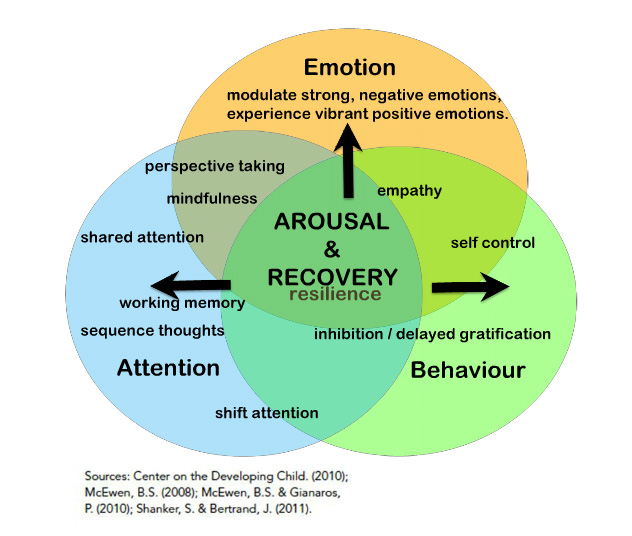
There are three key aspects of self-regulation.
Emotion regulation is the process of initiating, maintaining and adjusting the occurrence, intensity or duration of feelings.
Behaviour regulation is the organization of social interactions with others and the coordination of physical movements.
Attention regulation is the capacity to focus. It is the basis for persistence, curiosity, memory, cognitive flexibility, planning and problem solving.
Calmly focused and alert
The regulation of our arousal is important to the regulation of emotions, behaviour and attention. For a baby or young child, arousal states vary on a continuum from asleep to crying and unable to cope. Calmly focused and alert describes an arousal state in the middle that is open to receive and integrate information coming in from all the senses.
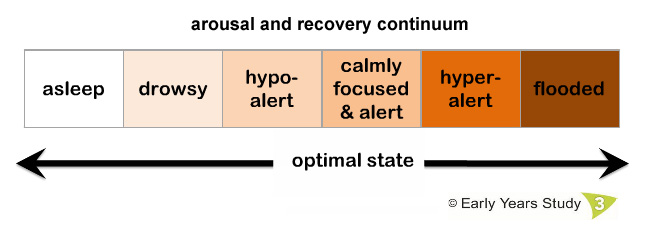
When experiences are overwhelming, this can be too much for young children’s arousal regulation. They may shut down or be on constant, high alert. Children vary in their abilities to deal with the various states along the arousal continuum, recover back to baseline, and cope with the highs and lows of energy within a given state.
Next watch as Shanker describes an example of a young girl being challenged by a hyper state of sensory arousal in the classroom.
Can you think of examples when you felt flooded and hyper-alert? Were you able to learn in that state?
How did you cope?
Try the next activity to review what you have learned about self-regulation.
So self-regulation is all about a child’s ability to maintain, or regain in a reasonable amount of time, a sense of calmness or focus when faced with challenges or distractions. Self-regulation cannot be taught by forcing children to do something they are not ready for, such as waiting long periods of time. It can be encouraged by recognizing the abilities of the child and providing the types of supports appropriate to his or her unique strengths and weaknesses.
On the next page, you will go deeper into the individual ways that children interact with the world.


