


3.1 Sustaining home life
Becoming parents
Families are central to the lives of children. Regardless of how children join their family, through birth, foster placement, adoption, intergenerational caregiving, or step-parenting, all new parents can experience a period of adjustment – physically, emotionally and cognitively. The often-daunting task of parenting can include many joys and challenges as parents navigate their new role. While parents certainly hold a large portion of responsibilities for their children, there are broader societal responsibilities for optimizing high quality child development that need to be considered. Community programs that support parenting, social policy that supports optimizing children’s full potential, and inclusion practice that considers the diverse socio-cultural contexts of all children and families can have a lasting effect on children’s developmental trajectories.
The late Dr. Alan Mirabelli, former executive director, explains how the vision of the Vanier Institute of the Family supports children, families and society.
Alan Mirabelli discusses the need for a society to value parents and families. Can you think of examples that demonstrate whether, as a society, we see the role of parents and families as important?
Considering all families
Every family is unique. Even families with similarities will have their own unique customs and traditions that make them who they are. To truly support families in their social contexts, those who work with them need to be aware of each family’s uniqueness by getting to know them, considering how to make each family feel they belong, and ensuring they are meaningfully represented and heard.
Listen to Dr. Shelly Mehta, professor and coordinator at the School of Early Childhood at George Brown College as she describes providing children and families a sense of belonging by ensuring their voices are amplified and heard.
Supporting families includes being aware of the various socio-cultural identities that exist, such as race, gender, class, sexuality, religion, disability, and more. In the following section you will review some of these identities. This information is general. What is true for one family can be different for another. Recall in EC 1.1, the discussion on intersectionality – the idea that socio-cultural identities overlap and intersect meaning individual families each have unique realities.
1. Race
The concept of race is complex. The American Psychological Association (2024) states, “Race refers to the social construction and categorization of people based on perceived shared physical traits” (para 1). It is only one of the many aspects that makes up a socio-cultural identity.
To see how race and other socio-cultural identities can impact a family’s experiences, read about Rosetta, Ian, and Christopher as newcomers to Canada.
Consider…
Christopher is a 6-year-old child attending an elementary school in Acton, Ontario… Read more
In this scenario, Christopher and Rosetta are singled out to represent a social identity they do not belong to simply because of their race. How do you think this makes Rosetta feel?
How can you avoid asking individuals to represent a social context they do not belong to?
Recall the definition of intersectionality in the Ecology of Childhood (EC) module, page 1.1. Can you see how Rosetta, Ian, and Christopher’s social factors have led to prejudice and oppression?
One way to work towards inclusiveness and belonging for children and their families is to begin to understand the impacts of the day-to-day experiences that may often go unnoticed or unrecognized. Recall the information on intersectionality in EC 1.1 that describes intersecting social categories that impact the lives of families. Racialized families with intersectional identities (race, gender, sexuality, ability, etc.) often hear and feel comments or thoughts that, upon closer inspection, are insulting. These are called microaggressions. Microaggressions can be unintentional as they tend to come from unconscious bias. You can explore different types of microaggressions in the following link. Once you become aware of microaggressions, you can avoid using them.
Recall the story of Rosetta, Ian and Christopher. What are some examples of microaggressions that Rosetta, Ian and Christopher have experienced?
What are some ways these microaggressions could have been prevented?
Should Rosetta join the parent involvement committee next year? Why do you think she is hesitant to join the committee?
Can you think of an experience of microaggression in your own life? How did you cope?
Listen as Dr. Shawnee Hardware, professor at the School of Early Childhood at George Brown College explains that critical reflection is an important first step in anti-bias education.
The following article with video provides guidance for families and caregivers to talk with children about race.
2. Anatomy, physiology, gender and sexuality
Anatomy, physiology, gender, and sexuality are complex concepts of socio-cultural identity. The language surrounding these concepts is important for everyone to know and understand so children and their families can be supported. Children develop at a rapid pace, including their language and identity development. When they do not see themselves or hear words that represent them, they make up words, struggle to fit in, and may not feel they belong. (Pastel, et al., 2019).
Shailja Jain, Professor at the School of Early Childhood at George Brown College, and PhD candidate, is researching gender justice, in particular gender expansiveness and gender affirmation within the early childhood context. In the video below, Jain talks about the importance of inclusive spaces in classrooms when supporting families.
The generalized acronym for gender and sexuality variations, 2SLGBTQIA+ (Two Spirit, Lesbian, Gay, Transgender, Queer, Intersex, Asexual or Ace, plus), has evolved over time. This acronym uses a selection of terminology, hence the +, meant to include everyone. Vocabulary is constantly being modified as contexts and experiences of individuals change. Individuals should determine the language used to describe themselves.
Individuals should also choose their own pronouns. Share your own pronouns and ask about other’s pronouns. See the link from the Government of Canada for more information about pronouns.
The link below provides vocabulary with descriptions to help us understand the nuances of each vocabulary term. Remember that language is evolving and changing, yet personal for each individual.
What terms are you familiar with? Are any new to you?
What term(s) can you use to identify yourself?
Read Chapter 1 of “Supporting Gender Diversity in Early Childhood Classrooms” for more information on supporting families and responding to and affirming children’s play, explorations, and expressions of their gender and sexuality.
Children have a right to explore their gender in a welcoming, warm and supportive environment without adult pressure. In the following video, Jain outlines how educators can embed gender affirming care for children and families. Jain advocates taking a gender justice approach that supports children’s gender agency, gender diversity, and gender health, suggesting that affirming identity in simple ways can make a big difference.
Consider the concept of gender affirming care when you read the following.
Consider…
Jamal is a 5-year-old Kindergartner at Centreville Childcare Centre in Centreville, New Brunswick… Read more
What are some ways that Ana and other educators can ensure that spaces are inclusive and safe for all children?
In what ways can Ana support Rashad’s wishes while dismantling the biases and fears that Rashad has?
Thinking about the gender justice approach, intersectionality, and health, can you think of a time when gender, race, culture, religion, language, or other any other factor impacted your experience? How?
In the following clip, watch as Amber discusses how staff at Splash Early Learning Centre have supported both children and families in similar situations.
In the next clip, Amber, along with colleagues Caitlin and Sam, describe why 2SLGBTQIA+ representation is important for children.
Now read as Lesley Massey, Executive Director of the Splash organization, with multiple child care sites in Winnipeg, Manitoba, recalls the experience of having their first transgender staff and the reaction of fellow staff members and children. Then listen to Sam, a Two-Spirit, Métis educator, talk about feeling accepted.
Consider…
I remember back in the nineties when the first transgender person joined our team… Read more
Understanding the meaning of justice and advocacy, the implication of language and vocabulary, and where to begin to become a gender advocate can be accomplished through continuous self-reflection and ongoing learning. Creating attuned, empathetic and caring relationships with children, their families and colleagues, as well as implementing an anti-bias educational framework despite one’s own discomfort, beliefs and fears, is central to positive early learning spaces and positive change that goes beyond ‘inclusion’.
Using gender affirming language is central to creating positive learning spaces. You can practice using gender affirming statements in the link below.
Educators can reflect on their own practice using the self-assessment and classroom audit tools at the end of each chapter in “Supporting Gender Diversity in Early Childhood Classrooms: A Practical Guide” (Pastel et al., 2019) in the link below.
You can listen to more from Dr. Zeenat Janmohamed and Shailja Jain in the Bright Beginnings: Insights into Early Childhood Education (Episode 6) podcast below.
Explore the Women and Gender Equality Canada’s (WAGE) Unity: Anti-stigma awareness campaign to access resources that support equality for 2SLGBTQIA+ people.
Supporting families
What do parents want and need to provide the best possible home base for their children?
Dr. Carl Corter, professor emeritus of Applied Psychology and Human Development at the University of Toronto, explains that parents need and want both tangible and intangible supports. Tangible supports include services that enhance the community, like libraries and playgrounds. Intangible supports include positive, respectful relationships between parents and the professionals who work with children.
He also gives examples of intangible parenting supports when he explains that parents want their society to view the parenting role as important. Parents also want input into the design and implementation of early years programs and services.
As you watch the following clip from the video, Family resource programs – Supporting the early years, enjoy the images of children having fun together, playing and learning, and the sense of well-being that is exuded by both children and parents in this setting.
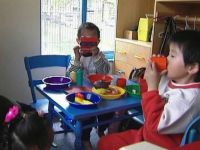
What are the elements of family resource programs that support child development?
What elements support parents?
The next clip tells the story of a young single mother who is struggling to find housing in an expensive city and how the family resource program community helps.

What kind of impact do you think the family resource program is having on the lives of this mother and child?
What if there had been no such program in her neighbourhood – what might have happened?
Dr. Maureen Black, professor of Pediatrics at the University of Maryland, recognizes the important role parents play – one that they are not always prepared for in an effective way. Note the ineffective, yet very common, strategies she describes. Dr. Black describes a coaching model used to “help parents be better parents”.
Think about a time you have tried to learn something new – perhaps a new skill, sport, or hobby. What techniques or strategies did your teacher or coach use?
What are the effective strategies Dr. Black describes?
How can these strategies be incorporated into existing programs in your community?
Besides in-person programs and services, there are other ways to support parents and provide information and resources. Online resources are especially important for those who cannot access in-person sessions. One such resource is MyBaby, a free, online resource that sends evidence-based video messages that demonstrate and explain positive parenting practices. The content also is a useful tool for professionals involved in parent education, home-visiting, and other parent support initiatives. Explore the MyBaby website and click on the featured topic of the week to see an example.
Consider how a resource like MyBaby can be used to reach out to and support families with babies in your community.
How does the MyBaby resource and the use of videos fit with Black’s description of the effectiveness of having parents and caregivers see others modelling certain behaviours?
The COVID-19 pandemic meant that many in-person programs and services had to move to an online format. In the first video, Dr. Leslie E. Roos, Assistant Professor in Psychology and Pediatrics at the University of Manitoba, describes the impact of the pandemic on parent and family well-being. In the second video, she shares an example of an innovative program developed to meet the needs of parents during the pandemic. Learn about BEAM, a smartphone/tablet app that supports the mental health needs of moms with new babies and young children.
What are the supports for parents in your community?
How were they adapted during the pandemic?
How can online or app-based programs complement in-person programs, and continue to support parents?
Early childhood programs
Children live within families. Early childhood education programs can work hand-in-hand with families, creating a community of and for families with young children. In such programs, early childhood educators act as a ready resource to answer the many questions parents have, to model effective practices, and to link parents to other community resources if required.
What do parents want and need to provide the best possible home base for their children?
How can early childhood programs support children’s home environments?
In the following video, learn about one mother’s experiences with the caregivers at her child’s centre.

In what ways does this mother find the centre supportive?
How do you think a trust relationship between parent and educator was developed?
How does this relate to the reading on child care quality in Section 2?
Caregivers are typically encouraged to develop positive and supportive relationships with parents. Listen to Patricia Chorney Rubin, director of Community Services and Early Childhood at George Brown College, share an interesting perspective on the concept of partnerships with families.
Chorney Rubin talks about reciprocity with parents. What does this mean? How is this different than cooperating and collaborating? What would be an example in your work setting?
Corter goes on to explain how early childhood educators can best support parents, by respecting them.
In the next clip, Corter points out that some parents need extra efforts.
In the Coping and Competence module you learned about children in care, and the large numbers of Indigenous children in care. Cindy Blackstock, executive director of the First Nations Child and Family Caring Society and a professor at McGill University’s School of Social Work, talks about some of the reasons for this, highlighting that there are broad systemic changes needed. In addition, she identifies some of the practical ways early childhood educators can support children in a variety of family situations.
In the next two videos, Brian Russell, from Dad Central Ontario, discusses the need to tailor resources to fathers in a way that will engage and value them.
For more information about Dad Central Canada and the resources Russell speaks about, explore their website.
Fatherhood is forever discusses the important role of fathers. This booklet includes information such as learning about being a positive role model for children and some of the approaches fathers can take to deal with different situations.
Dr. Zeenat Janmohamed, Executive Director and Senior Policy Analyst at the Atkinson Centre, discusses that early childhood educators’ support to same-sex families can be particularly important if those families do not feel supported by their own extended families.
Parents and other primary caregivers bring intimate knowledge about each child and his or her family and cultural context. They also learn from others and expand their own parenting/care giving capacity. Environments can be structured to invite participation by parents and caregivers.
Pat Furman, executive director of Inspired by Wonder in Winnipeg, reflects on the range of ways staff build relationships with parents.
Pat Furman highlights more than a broad array of activities or events – she outlines a well thought out process that is grounded in respect for families. How is this evident? Why is this important?
It is always inspiring to hear new ideas. Are there any that you think might be suitable in your work with families?
In the podcast, Bright Beginnings: Insights into Early Childhood Education (Episode 1), Dr. Emis Akbari interviews Tennelle Wong, a parent of a child with additional support considerations. Listen as Tennelle describes the support she received from the early childhood educators leading up to her child’s diagnosis as well as the consistent support the family received while attending the program. You can stop listening when the interviewer mentions Covid.
Sometimes there are excellent programs, but they do not reach all who need them. The late Dr. Clyde Hertzman discusses some common barriers that prevent access.
Programs and supports that promote child survival and development through parent education are particularly significant and can be delivered in many different ways. The next video highlights a parenting program in Aswan, Egypt.

A 2016 report from the National Academies of Sciences, Engineering, and Medicine, identifies effective parenting practices, as well as elements of effective interventions to support parents.
Child life programs
In many countries around the world, a healthcare clinic or doctor’s office is another type of environment with which a child regularly has contact, perhaps for regular check-ups or well-baby visits. When children have to undergo tests or procedures that go beyond these normal situations, child life specialists can provide information and support.
“Child life” is a professional discipline with an overarching goal of supporting children and families in stressful situations, particularly those related to health care experiences. Child life specialists are trained in child development and family dynamics so that they can help young patients and their families cope with the challenges of hospitalization and other health care related concerns.
Listen now as Renee Ethans from the Winnipeg Children’s Hospital explains child life services and explains how the profession began.
Hospitalization can be a difficult experience for the patient as well as his/her family members. The following reading from the Canadian Child Care Federation is a helpful resource to share with parents whose children will be going to the hospital whether as an out-patient (not staying over night) or as an in-patient (being admitted and staying overnight).
In the next video, Ethans provides more details about the role of the child life specialist. You will see scenes of children participating in medical play sessions to help them prepare for upcoming hospital visits.
How do child life services help support families?
What do you think the experience is like for children and families when these services are not available?


