


1.1 Acquiring language

Humans have the unique capacity to create and use language. Other animals can communicate with each other, but their limited numbers of calls or gestures are isolated signals with very specific messages. Human language is flexible and productive – a small number of individually meaningless symbols (sounds or gestures) can be combined according to a set of shared rules to produce an infinite number of messages. It is estimated more than 7000 languages are spoken in the world today (Eberhard et al., 2020).
The following reading explains five key elements of language with examples from the English language.
Children begin to communicate at birth using sounds and then gestures. Oral language greatly expands the way in which children can express their needs, exchange ideas, express feelings and connect with others. The capacity to communicate with language also expands children’s capabilities to regulate their emotions and behaviour and to get along with others. Adults around them often observe that as they learn to talk, children become less like babies and more like “little people”.
Humans are prepared to communicate from the moment they are born. Dr. Janet Werker, research chair, Department of Psychology at the University of British Columbia, explains the remarkable spoken language skills of newborns.
Interestingly, adults seem also to be prepared to speak in a certain way to infants and young children. In the next clip, Werker describes the term motherese and explains that many suggest that it should be called, parentese since mothers are not the only adults who do it. The terms infant-directed speech or child-directed speech have also been used to describe this unique ways of speaking.
Consider the numerous preferences and abilities newborns show, indicating they are prepared to develop language. Were you aware of these? Does this have an impact on your view of babies?
How do parents in your culture speak to young infants and young children?
Infants are more responsive to higher-pitched voices. Simple, clear enunciation is easier for children to understand. This makes parentese perfectly suited to their auditory preferences. It is also adapted to development. Adults modify their language interactions based on children’s growing skill and even deaf parents use a form of parentese when signing to their babies (Berk, 2012). Interestingly, this accommodation on the part of adults is largely unconscious. In the next video, Melanie Soderstrom, associate professor in the Department of Psychology at the University of Manitoba, discusses the implications of the research on infant- and child-directed speech (see p. 2.1 in this module for a look at how this research is done).
In the next KidCareCanada video, Dr. Thomas Boyce explains the connection between nurturing relationships and early language development.
In the Brain Development module, we watched an example of a “serve and return” interaction between two-month-old Jersey and her mother. When you watch this clip now, keep in mind the description of parentese that Werker provides as well as Soderstrom’s message to parents and Boyce’s description of the emotional back and forth between a parent and infant.

How does the way the mother speaks to her baby fit with what you’ve learned about parentese?
What does Jersey do that encourages her mother to keep up the ‘conversation’?
Now watch as Jakyri and his father share a banana and have a conversation:

How does Jakyri’s father support his efforts to communicate?
What does this scene tell you about their relationship?
The next reading reviews typical language abilities of children through the first five years.
In the next video, Nicole Kornelson, Registered Speech Language Therapist in the Northwest Territories, describes receptive and expressive language.
The next video is from the documentary The Beginning of Life. As you watch this clip, consider how the examples of adults listening, singing, reading, and talking support children as they acquire language.
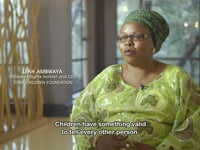
What are the key message for parents and caregivers about communicating with infants and young children?
What is the ’30 million word gap’ and what is the impact on children’s language acquisition? How can parents and caregivers “keep children talking” to help minimize this gap?
Children’s language acquisition is fascinating. Try the following quiz to review information from the readings and videos on this page.


