


3.3 Creating curriculum

- What is a curriculum in an early years program?
- Is there one curriculum that is best to follow?
- How is a curriculum for children developed?
- How do you ensure it reflects each child?
In the simplest of definitions, curriculum is what educators do and pedagogy is how they do it. Think about this distinction as you explore this page.
There are many different ideas as to what a curriculum can and should look like for young children and what pedagogical approach is appropriate. Each program is unique in accordance with the social and cultural context of the community and families it serves.
Programs for young children differ in many ways, including the goals or focus of the programs, the ages of the children, whether parents are also offered support and services, whether there are multiple goals to the program and so forth. Even though there are many variations in programs for young children, a curriculum offers a plan for designing and orchestrating the environment and experiences.
Quality early childhood programs have common principles, approaches and tools that guide practice. There is recognition that children’s earliest experiences matter deeply, laying the foundation for lifelong learning, behaviour and health. . . Research also shows that a planned curriculum, anchored by play, best capitalizes on children’s natural curiosity and exuberance to learn” (McCain et al., 2011, p. 52).
To learn more about the role of curriculum in the provision of quality early childhood programs, read the section, Components of quality early childhood education, in the Early Years Study 3 by McCain et al. (2011, pp. 52 – 54).
The curriculum continuum graphic on p. 53 of the reading (Figure 3.3) shows that curriculum approaches vary in how much emphasis is on the children’s initiative and how much is on the educators’ guidance and direction. Using that graphic, consider an early childhood program with which you are familiar.
Are child-directed and adult-guided strategies used effectively?
Have there been situations that you think qualify as laissez-faire chaos and/or didactic schoolification?
How might this diagram be used with educators to help them improve their practice?
Curriculum reflecting community
The late Dr. Mike Niles, a professor of Social Work at Arizona State University and a creator of the Indigenous Early Intervention Alliance, talks about the idea of “best practice” and curricula in Indigenous communities in the United States. His comments are relevant to how we think about creating curricula with a community rather than “applied” to a community.
Niles says he encourages educators to think about who they are, what they bring to the community and what it means to be a community member. Consider these questions and reflect on your role in the lives of children and families.
Dr. Angela James, a Métis educator, lives in the Northwest Territories where she has studied the Dene and Inuit perspectives on raising and educating children. Read her account of how this “capable person” concept is reflected in the curriculum of early childhood programs.
In the following video, Dr. James explains how, in the Northwest Territories, educators can balance Indigenous and Western approaches in early learning.
Dr. James describes a model to balance Indigenous and Western approaches to learning. In what ways can you balance Indigenous and Western approaches?
What concepts shared could you use in your own work with children?
Listen as Lori Huston, a Métis early childhood educator, scholar and doctoral candidate in Curriculum Studies at the University of British Columbia, explains heart pedagogy, an Indigenous pedagogy she is studying.
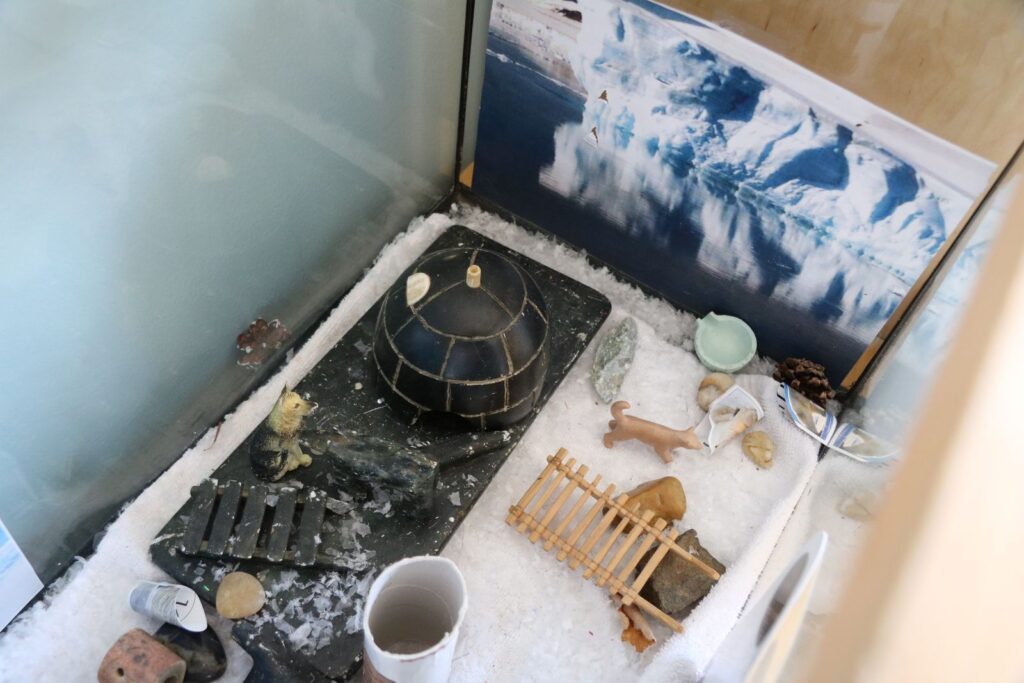
Carol Rowan has spent the last forty years travelling and working between Inuit Nunangat and Montreal, Quebec. Her interest is in living Inuit ways of knowing and being through pedagogy and curriculum, in places where young children and families are engaged. The trail has involved working in communities with Elders, parents’ children and teachers. This work has led to the construction of child care centres, the adoption of policy, the development of organizational manuals, and the creation of curricula. It has involved teacher/parent education, the making of Inuktitut language children’s books, the assembling of learning stories and a proposal to adopt Nunangat pedagogies as strategy to think with land, snow and ice. Watch the following two clips as she describes how Elders determined the pedagogical practice, leading to curriculum, in an early childhood education setting.
Huston explains that heart pedagogy comes from an Indigenous voice. In what ways can you connect with Indigenous voices?
Rowan explains a collaborative approach to curriculum where Elders were consulted about curriculum and pedagogy. How can you collaborate with others to create more meaningful learning experiences?
In this video, Elder Stella Blackbird shares her vision about the need for a children’s program grounded in traditional Indigenous values. You will see the transformation of an old department store in the heart of Winnipeg’s North End into a beautiful building reflective of Indigenous cultures where generations meet, play and learn together.

The next reading is a part of the Moving Child Care Forward project, and it is found on their website. It explores the need for, and implementation of, high quality Aboriginal early childhood education. Please note that at the time this brief was published, the word “Aboriginal” was used to describe the original peoples of Canada; however, today the word “Indigenous” is more accurate and common.
There are many approaches to curriculum. The Abecedarian approach, emergent curriculum and Reggio Emilia are highlighted. The final section in this module provides information about the curriculum frameworks many jurisdictions have, and how practitioners can identify their image of the child, vision, beliefs and practices, and articulate that for staff and parents.
Abecedarian approach

The Ecology of Childhood and Developmental Health modules have information on the Carolina Abecedarian project, which is a targeted early intervention program that provides high quality care to children growing up in extreme poverty. Often children living in poverty face multiple barriers to development in all domains and are particularly at risk for poor academic achievement. The Abecedarian approach was designed to counteract these barriers by placing a high priority on language acquisition, based on research that links higher language proficiency in early childhood to stronger academic outcomes when the child enters school. This language priority is supported by three core features: Enriched Caregiving, Conversational Reading, and Interaction Games (previously called LearningGames). All aspects of the approach are carried out with a focus on individual, frequent, and intentional interactions between the caregiver and child, which deepens the child-caregiver relationship. In the next videos, Dr. Joseph Sparling, one of the investigators and developers of the approach, discusses its three core features.
How do the strategies that Sparling describes fit with your understanding of high quality early childhood care and education?
Do you think these are practices that all good educators would naturally do or is training required?
Emergent curriculum

Emergent Curriculum is an approach to program planning in early childhood settings that is becoming a widely respected practice. Based on the interests of children, it involves careful observation, attunement to children’s thinking, and a genuine partnership between adults and children in the process of learning.
In the next clip, Marc Battle, a faculty member of the Early Childhood Education program at Red River College, explains the meaning of emergent curriculum, stressing the importance of collaborative relationships between adults and children:
In the following article from the National Association for the Education of Young Children, Elizabeth Jones explains emergent curriculum and contrasts it with standardized curriculum.
What is it about emergent curriculum that makes the educational process so individualized?
Why is this important?
The next video demonstrates an example of an emergent project, which Marc Battle participated in, centred upon children’s interest in “machines”.

The Machines video points out the wide scope of learning opportunities when children are actively exploring a topic that they are interested in. Dr. Lillian Katz, professor emerita of Early Childhood Education at the University of Illinois at Urbana–Champaign, discusses the project approach in the following videos.
Sarah Silver, former executive director of the University Children’s Centre in Halifax describes their journey towards emergent curriculum, and how the importance of reflective practice has become crucial.
Reggio Emilia
As the earlier reading by Jones (2012) points out, an important influence on early childhood programs in the last few decades has been the exemplary preschools in Reggio Emilia, Italy. These programs have impressed educators with their ability to nurture and also support childrens learning at a very high level within a playful environment. Great attention is paid to detail, to children’s thinking and to how they express their experience in various “languages” — verbal, visual, kinesthetic and so forth. In the next videos, Dr. Lillian Katz discusses two elements of the Reggio Emilia approach.
To learn more about these schools, the exhibitions of children’s art, and the approach, visit the following website.
Listening to children, being attuned to their interests, providing a rich but not overstimulating sensory environment and a secure base of attachment, together, are the essence of what is needed to support children’s communicating and learning. Policies, programs and environments for young children should be designed to support and ensure these practices.
Early learning curriculum frameworks – pulling it all together
An early learning curriculum framework is a guide to creating curriculum and pedagogy that complements and supports a variety of specific curriculum approaches. It is based on agreed-upon principles, shared language and understanding about how children learn and develop. The goal is to support educators in a variety of early childhood programs while recognizing distinct family and community values that also influence curriculum. An early learning curriculum framework is a dynamic document that evolves as it is used.
Listen to Dr. Patricia Chorney Rubin, George Brown College, discuss the concept of curriculum frameworks.
Tove Mogstad Slinde is a senior advisor in the Norwegian Ministry of Education and Research. In the next video she discusses the Norwegian journey developing a pedagogical framework in their kindergartens. Note that in Norway Kindergarten refers to programs for children up to starting school at age 6.
Explore the Norwegian government’s website to learn more. Download and read the Framework Plan for Kindergarten that came into force August 1, 2017. The objectives and content section lists a variety of components that should be incorporated into Kindergartens. Jot down these components then view the “video for inspiration” and identify examples of each.
In the next video, Slinde explains how the framework plan is part of the overall system for quality in Norway.
What have you learned about the Norwegian system that surprised you?
What might apply to the system in your jurisdiction?
In Canada, several provinces and territories have developed curriculum frameworks and related resources to guide early childhood education. Some have specific curriculum program guides for Kindergarten. In the United States, most states have documents that outline early learning standards rather than “curriculum frameworks”. These are often outlines of what children should be able to do at different ages and stages along with descriptions of practices and learning environments that support children’s development.
Click on the next link to see a listing of curriculum frameworks, kindergarten program guides and early learning standards for Canadian provinces and American states, along with some international examples.
Listen to some thoughts about how practitioners put this into practice.
Listen to Pat Furman, Director of Inspired by Wonder (formerly, Robertson Early Enrichment Program) in Winnipeg, talk about the program at this centre and how they have adopted components of others programs and put their philosophy into practice.
Consider…
It is time to consider what you have learned, what research supports, and to reflect on what this means to you and how it will inform your practice.
What is your image of the child?
What do you believe about how children learn? Why?
What practices do you believe best support children’s learning?
You have reached the end of the Communicating and Learning Module. Go to the homepage to choose another module.


