


2.1 Early regulatory systems
Consider…
It is two o’clock in the morning in a downtown high-rise apartment, and four-month old Julien is beginning to stir from a deep sleep. At first, Julien’s cry is intermittent and quiet, but after ten minutes, Julien is fully awake and screaming… Read more
This is a common situation for many parents. What do you think about how Julien’s parents responded?
What advice have you heard about responding to a crying baby? Do you agree or disagree and why?
How do you relate this to what you have learned so far about coping and competence?

In the early days and months after birth, human infants master a number of tasks, including maintaining body temperature, organizing the body’s reactions to external stimulation, adapting awake and sleep cycles, signalling needs to important adults and beginning to soothe themselves.
These early regulatory tasks are essential to coping to life outside of the womb. They establish the foundation for managing powerful emotions, paying attention and getting along with others.
As you watch the next video, pay attention to the baby’s cues or signals and how the parent responds.
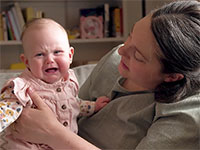
Hidden regulators: Infant-mother interactions include touch, temperature, sounds, smells and movement that exert an unobserved, discrete impact on regulating the infant’s physiological system and behaviours such as crying (Hofer, 2010).
Dr. Ron Barr, professor emeritus in the Department of Pediatrics at the University of British Columbia, studies the role of hidden regulators in regulatory processes. In the following clip, he describes the biological pathways used by mothers and babies to relate to each other. He explains research looking at how newborn babies respond to a brief painful procedure based on whether they are held by their mothers or not.
Caregiving practices, including how best to respond to a crying baby, sleep routines and feeding practices, vary across cultures. Read about this variety and specifically caregiving practices based on closeness versus separation strategies.
Barr’s description and the reading above raise all kinds of interesting and speculative questions. For example:
- What are some factors in our society that support a “separation” strategy? Do you see examples that this is changing?
- What are some of the benefits and drawbacks of each approach to caregiving – separation or closeness/attachment for either the infant or adult?
- What advice would you give parents about how much to hold their babies and how promptly to respond to an infant’s distress?
- Think about your own upbringing – how were you raised? Was it more towards a separation approach or more toward closeness?
Crying
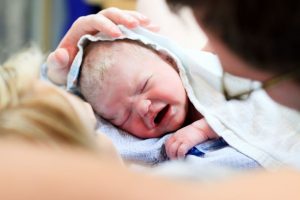
Crying signals a baby’s needs to caregivers. At birth, or shortly after, infants typically have four distinct types of cries: the birth cry, the pain cry, the hunger cry and the pleasure cry (Lamb & Lewis, 2011). The birth cry occurs only at birth and is how the infant clears out amniotic fluid from the lungs and trachea. The other cries are often signals to caregivers and may be difficult to distinguish. Unlike other species, and often to their caregivers’ dismay, human babies may cry for no apparent reason.
In the following clip, Barr discusses why some babies cry much more than others.
The news that babies who cry a lot may have stronger survival capacity may be a comfort to parents of babies who cry a great deal, but nonetheless, it is very difficult for parents and others to listen to babies cry. In the next video, Barr describes the term PURPLE crying, in which PURPLE is an acronym for the characteristics of crying sometimes seen in the first weeks and months of a baby’s life. Explore the website that follows for more information, including how the term “colic”, sometimes used to describe excessive crying, tends not to be helpful for adults caring for an infant who cries a lot.
Whether a baby displays some or all of the characteristics of PURPLE crying or not, most caregivers struggle with how to stop a baby’s crying. Dr. Joan Durrant, professor emerita of Community Health Sciences at the University of Manitoba, explains how responding to crying provides infants with safety and security. The reading that follows, from Abilio, summarizes some of the research on crying.
Do the comments of Barr and Durrant, as well as the reading above, alter your understanding of crying in infancy and, if so, how?
St. James-Roberts distinguishes between crying caused by colic and crying of a child with a negatively reactive temperament. What are the main differences?
What information did you learn in the above videos and reading that might help parents cope?
In the next clip, Barr discusses more research about the biological connections between mother and babies.
What do researchers know about crying behaviour in young children? This article, from the Encyclopedia on Early Childhood Development, provides a synthesis.
Sleeping

As mentioned above, early sleep regulation is one of the first tasks for a newborn. Newborns tend to sleep a lot, usually in many different segments throughout the day and night. Encouraging healthy sleep practices is often a prime concern of new parents. Earlier information on this page describes various baby-care practices including whether mother and baby sleep together. Dr. Christine Ateah is vice-dean in the Faculty of Health Sciences and professor in the College of Nursing at the University of Manitoba. In the next video she compares the types of beds used in different parts of the world and explains how this affects the North America public health recommendation that parents co-sleep, with baby sleeping in the same room as the parent but on a separate sleep surface.
In the next video, Ateah describes a survey that found that while the majority of mothers are aware of the risks of bed sharing, most of them do bring their infants into their beds.
Click on the link below to read the pamphlet mentioned by Dr. Ateah called, ABC’s of safe sleep for baby. It is from the Provincial Advisory Committee on Child Abuse. Notice that one recommendation is that having “baby’s crib in the caregiver’s room for the first 6 months allows the benefits of close sleeping without the risks of bed sharing”.
The reading that follows is from the Encyclopedia on Early Childhood Development. It provides an overview of the normal development of sleep from the newborn period on, common sleep problems as well as some solutions. The ParticipACTION website reviews recommendations for physical activity, sedentary behaviours, and sleep requirements for infants, toddlers, and preschoolers in each 24-hour period.
Although sleep problems are common, they can be a significant source of concern for parents and caregivers. Getting enough sleep promotes healthy growth and development. While the amount of sleep children need varies with age and individual, there are some general guidelines regarding the amount of sleep children need and how to promote healthy sleep habits. The following webpage from the Canadian Paediatric Society, is a helpful resource for caregivers interested in promoting healthy sleep habits for young children.
Sudden Infant Death Syndrome (SIDS) refers to a death that occurs during sleep before a child’s first birthday without an identified cause. The document below provides more information about this public health concern. It addresses the principles of safe sleep, including the importance of infants sleeping on firm mattresses, made for infants, not for adults. These recommendations are based on large epidemiological studies that have considered the main risk factors for SIDS and how to modify them to reduce the risk of infant death.
Click on the link below to explore the Government of Canada recommendations on safe sleep, including what caregivers can do to reduce the risk of SIDS.


