


1.1 Self-regulation

Self-regulation is “…an ability to be boss of one’s own attention, emotion and behaviour at an appropriate level for one’s age and culture” (Clinton, 2020, p. 51). This involves taking into account not only our own thoughts and feelings but those of others as well. Self-regulation is central to our transition from helplessness to competence.
Researchers from various disciplines have emphasized physiological, cognitive, neurological, psychological and social dimensions of self-regulation as well as regulatory problems (Vohs & Baumeister, 2010). They share the common idea that self-regulation is a central set of interrelated skills and abilities that influence learning, behaviour and health.
Dr. Stuart Shanker, distinguished research professor emeritus at York University, describes what is meant by the term self-regulation and how it is inextricably connected to early brain development.
Listen now as Dr. Jean Clinton, clinical professor of Psychiatry and Behavioural Neuroscience at McMaster University, describes the adult’s role as a co-regulator for the infant.
Consider Clinton’s message as you watch the next video of a parent and 4-month-old.

How is this parent acting as the “external brain” for the upset baby?
Dr. Carl Corter, professor emeritus at the Ontario Institute for Studies in Education at the University of Toronto, discusses how a young child’s experiences influence the development of self-regulation.
As Shanker and Corter point out, children learn self-regulation by being regulated.
Consider…
Eyad
8-month-old Eyad wakes from his nap. He sits in his cradle and sees his mother and grandmother just outside the door…Read more
In each of these situations, what do you think Eyad is learning about his world?
What do you think he is learning about himself? His mother and grandmother?
How is he learning to cope?
Based on what you have learned from Shanker, Clinton and Corter, how may Eyad’s experiences be affecting his developing self-regulation?
The next two videos show examples of caregivers helping infants and young children develop self-regulation – in other words, co-regulating. If you watch carefully, you will see many examples in the ordinary, everyday moments illustrated in these clips.


What aspects of developing self-regulation did you notice in the examples?
How did the caregivers support the children in their attempts to self-regulate the scenes ‘Naptime’ and ‘More Grapes’? How did the mother in the second scene help her son gain control of his emotions?
What about The Knot? A lot happens in this scene in a few seconds. How does does the educator help Cole ‘save face’ and support his developing self-regulation in a subtle way?
Calmly focused and alert

The regulation of our energy is central to how we regulate our emotions, behaviour and attention. Arousal states operate on a continuum from asleep to crying and unable to cope. Calmly focused and alert describes an arousal state in the middle that is open to receive and integrate incoming information from the various senses.

When experiences are overwhelming, a young child’s arousal regulation can be overwhelmed. Young children may shut down or become on constant, high alert. Children vary in their abilities to make gradual and rapid changes across the arousal continuum, recover back to baseline, and modulate the highs and lows of energy within a given state.
Shanker explains how the parasympathetic and autonomic nervous systems interact to shape arousal states.
Next watch as Shanker describes an example of a young girl being challenged by a hyper state of sensory arousal in the classroom.
What does this story bring to mind for you?
Can you think of similar examples?
Consider…
Marsha
Marsha is getting ready to take her two-year-old daughter Aisha outside. It is winter in Saskatoon…Read more
The next reading discusses how stressors can affect arousal level and thus a child’s ability to self-regulate. It also reviews some common stressors in the early years and the five steps of the Shanker self-regulation method, which is discussed in more detail on p. 3.1 of this module.
Urie Bonfenbrenner once said, “All of us partly see the world through the eyes of the child we once were” (Konner, 1991, p.12). If we carry forward our arousal regulation ‘thermostat’ from childhood, are we seeing and understanding our world partly through our childhood eyes?
Can you think of examples when you felt flooded and hyper-alert? Were you able to learn in that state? How did you cope?
Self-regulation and learning, behaviour and health
There are 3 key aspects of self-regulation:
Emotion regulation is the process of initiating, maintaining, and adjusting the occurrence, intensity or duration of feelings.
Behaviour regulation is the organization of social interactions with others and the coordination of physical movements.
Attention regulation is the capacity to selectively and consciously focus. It is the basis for persistence, curiosity, memory, cognitive flexibility, planning and problem solving.

In the next video, Corter discusses how regulatory systems develop in early childhood.
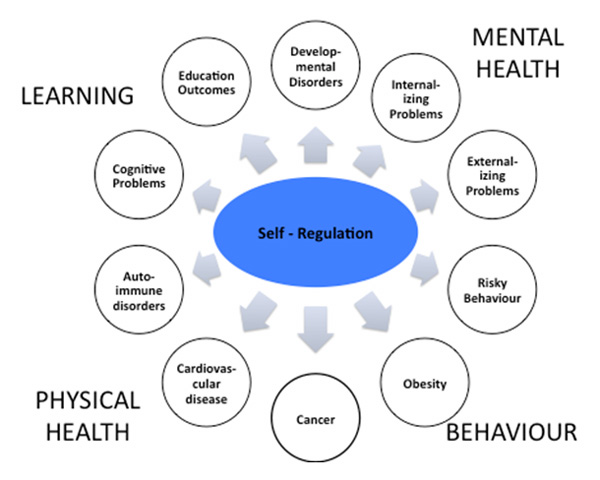
In the following clips, listen as Shanker explains how our arousal/recovery thermostat influences lifelong health, behaviour and learning.
Describe how too many stressors may contribute to obesity, learning difficulties or risky behaviours.
Do you think optimal self-regulation improves an individual’s health?
Shanker states that suggesting children need more will-power can actually be harmful. Why?
Self-regulation and self-control
Many people confuse self-regulation with self-control but this is a misunderstanding. In the next clip, Shanker explains the difference.
Listen now as Clinton adds to his explanation.
Shanker goes on to explain some classic research on the development of self-control.
Click on the interact below for an infographic from the MEHRIT Centre, a social enterprise that focuses on mindful self regulation, established by Dr. Shanker. The infographic explains the distinctions between self-regulation and self-control. As the infographic explains, “self-regulation makes self-control possible, not the other way around”.
How would you explain the difference between self-regulation and self-control to colleagues or parents?
This research indicates a child’s ability to control their impulses at age four is associated with many longterm outcomes. Were you surprised by the findings? Why or why not?
Why do you think a relaxed state makes such a difference in a child’s self-control?
Can you see any implications for parents and adults who work with young children?
Play and self-regulation

During play, children have opportunities to practice the type of skills that are fundamental to self-regulation – flexible thinking, focused attention, goal-directed behaviour and the ability to negotiate and cooperate with peers.
Carl Corter explains what researchers are learning about the relationship between self-regulation and play.
Have you seen children engaged in dramatic play that allows them to explore the self-regulation skills that Corter mentions, e.g., being flexibile, using working memory, staying in a role and practicing inhibition?
Page 2.6 in this module, Play, coping and competence, explores more on this topic and other research related to play.


