


2.3 Emotional learning

If you ask most parents what they want for their children in life, their answer is that they mainly want their children to be happy. But how does this happen? Can we teach happiness?
Watch the next video to learn more.

What role do parents play in helping their children learn to be happy?
How might you, in your work with children, support parents in helping their children learn to be happy?
Happiness is one of a wide spectrum of emotions that develop in early childhood. Children begin with a few simple emotions (happiness, sadness, anger) but, especially as they develop social cognition, gradually display other more complex emotions (jealousy, shame, satisfaction). In the next video, notice how the parent labels and supports her baby’s emotional responses.

The following reading, from the Encyclopedia on Early Childhood Development, provides an overview of emotional development in early childhood and discusses how children develop emotional competence. Try the interact that follows to review some concepts from the reading.
The following paper, from the Center on the Developing Child, describes how emotional development is built into the architecture of children’s brains.
The article states that emotional development is not given the same attention and recognition as other areas of development such as cognition and language. Have you found that to be the case?
If so, what are some ways to raise awareness about the importance of emotional development?
The Encyclopedia on Early Child Development has a wealth of additional content about emotional competence. Read the topic synthesis and explore the other material on the site.
Stress behaviour and misbehaviour
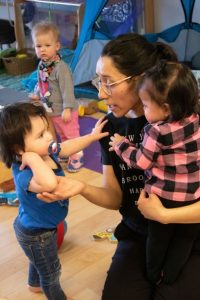
As children grow, they are expected to gradually learn to control their emotions and behaviour. On page 1.1 in this module, Dr. Stuart Shanker, distinguished research professor emeritus at York University, explained the difference between self-regulation and self-control.
In the next clip he discusses this in terms of brain development and distinguishes between what he calls “red brain” (when the brain is dysregulated and self-control is difficult) and “blue brain” (when a child is calm and focused) states.
Shanker goes on to explain the difference between stress behaviour from misbehaviour.
Shanker stresses that when a child is in the “red brain” state it is very difficult for them to learn, to be aware of their surroundings and to change their behaviour. It is not the best time to expect them to listen to reason. Shanker has a method for helping children with emotional regulation that is explained on page 3.1 of this module.
Children express stress differently at different ages and at time, may regress in their emotional expression.
Aggression
All children demonstrate some aggression early in life, especially as toddlers. Learning to channel aggression in socially acceptable ways is key to developing social competence, including positive peer interactions.
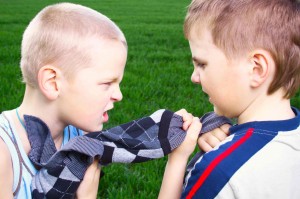
Dr. Richard Tremblay, child psychologist and professor of Pediatrics, Psychiatry, and Psychology at the University of Montreal, has been studying aggression trajectories from early childhood to adolescence and beyond for many years. Listen as Tremblay begins this discussion of childhood aggression by describing the Montreal Longitudinal Study and the variability of aggressive behaviours.
In the next clip, Tremblay explains why it is important for children to learn to regulate aggression during the preschool period.
Now Tremblay highlights an intervention that was implemented with boys who showed high risk behaviours.
Tremblay discusses the importance of helping children learn to curb physical aggression in the first three or four years of life.
What aspects of the environment do you think help children learn to control aggression and become socially competent?
Tremblay discusses an intervention program used in the study with high risk boys. Can you see how what they did might be implemented on a wide scale? Do you know of such a program?
Listen as Tremblay describes the value of play fighting, which is a particular type of active play commonly referred to as rough-and-tumble-play.
The following provides a good synthesis of research on aggression in young children.
Were there any surprises for you in this reading?
The author mentions a number of social determinants such as low income and education that are associated with higher levels of physical aggression among boys. Why might that be the case?
Adults tend to notice and intervene more with physical aggression than relational aggression although both are equally damaging. What can be done about this?
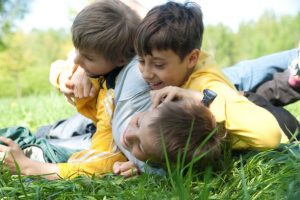
In early childhood settings, behaviour management can be very challenging. Trained, experienced staff know that an interesting, busy program, an engaging well-planned environment and sensitive nurturing are key to keeping children happy and constructively occupied. Still, as Dr. Richard Tremblay says, a certain amount of physical aggression is normal among young children. Many programs and individuals who work with children have a low tolerance for rough-and-tumble play or play-fighting which is popular, especially among preschool boys. Tremblay has a different take on this, one that is supported by research. In the next video, Marc Battle and Melinda Walden – both Early Childhood Education instructors – discuss rough and tumble play among school-age children.
If children an early childhood program show an interest in play-fighting and rough-and-tumble play, how might you use the evidence on this page to have a discussion about including this type of play in the program?
How might it be managed in a way that is psychologically and physically safe for children? Are there any community characteristics that might impact the approach you take?
This next reading by Sergio and Vivien Pellis from the Encyclopedia on Early Childhood Development reflects Tremblay’s ideas, and further discusses the role of play-fighting to foster positive social skills, enhance emotional self-regulation and prevent aggression later in life.
To learn more about the topic of aggression in childhood explore the following topic folder in the online Encyclopedia on Early Childhood Development.
Prosocial behaviour and moral development
As discussed above, part of developing social competence is learning how to channel aggressive impulses. Children need to be able to replace aggressive actions with more socially acceptable ones. Behaving in prosocial ways is another aspect of social competence. As explained in the next reading, prosocial behaviours are actions people do to benefit others or to protect them from harm. The reading explains that moral development underlies prosocial behaviours and describes why prosocial behaviour is important, what we know about it, and suggestions for encouraging prosocial behaviour in young children.
This article describes some early prosocial behaviours demonstrated by 18-month olds. It is possible to study moral development in even younger children. The next video shows how some research is done on infants’ moral choices. This video was filmed at the University of Manitoba, in a lab run by Dr. Melanie Soderstrom. She describes the research methodology they use (originally developed by Kiley Hamlin) as well as its challenges.
Soderstrom describes specific aspects of the research protocol and design, such as the parent keeping their eyes closed and positioning the child a certain way, and the researcher being unaware of which shape was the “helper” and which was the “hinderer”. Why are these important?
Why is it important to be aware of exactly how research is done in order to critically evaluate the findings?
The study demonstrated in the video above is one of many studies investigating early moral choices. Van de Vondervoort and Hamlin (2018) explain that while studies in this area have shown that infants have a preference for people and objects that behave in prosocial ways over those who are antisocial, more research is needed to understand why the infants show those preferences. For example, are the prosocial preferences due to infants being concerned about their own well being, about morality, or both?
See the next reading, from the Encyclopedia on Early Childhood Development, for a discussion on how moral development and prosocial behaviours are linked.
Social cognition
Studies show that our understanding of mental states and awareness that all people have their own point of view, feelings and ideas develops and deepens gradually in childhood. This awareness is called social cognition. Children who understand that other people have their own thoughts and feelings usually have better social skills than those who don’t.
The Encyclopedia on Early Childhood Development provides the following synthesis on social cognition research.
As the reading points out, it is important to help children develop their social cognitive abilities early in life. Dr. Michal Perlman is a professor in the Department of Human Development and Applied Psychology at the Ontario Institute for Studies in Education. In the next video she describes meta-cognitive language, which refers to an individual’s language that shows awareness of another person’s perspective, thoughts, or feelings. She briefly describes her research in child care programs looking at the use of meta-cognitive language.
The following are a couple of examples of meta-cognitive language. Can you think of more?
- An early childhood educator notices a child is pouting, and acknowledges the child’s feelings by saying, “You seem very upset.”
- A mother hears her daughter yelling loudly at her little brother. The mother says, “It sounds like you are angry with him about something”.
Do you often hear parents and caregivers using meta-cognitive language?
How do you think parents and staff in early years programs could be encouraged to use more meta-cognitive language?
Perlman suggests the need for training interventions to encourage more use of meta-cogntivie language by staff in early childhood programs. What do you think such an intervention might look like?
How important do you think it is to link interventions with research?


