


2.2 Stress

How does stress affect child development? Can some stress be good? What does “toxic stress” mean?
We often hear about the negative effects of stress on human health. On this page, you will look more closely at how stress affects early brain development and the longterm outcomes for various types of stress.
We all experience stressful situations and our bodies react to these situations. The magnitude of the stressor along with support systems, if any, around us influence the long term impact of stress.
In the next video from Tajikistan, watch as young Yusuf gets his first needle at the local health centre.

How did Yusuf respond when his mother was able to pick him up after getting the needle? How did he react when she put him down to dress him?
What does this scene tell you about the role of his mother in helping him to handle this stressful event?
Who was more stressed, Yusuf or his mother?
For Yusuf, the pain of the needle activated a biological and behavioural stress reaction. Dr. Megan Gunnar is a professor and former director of the Institute of Child Development at the University of Minnesota who studies the biology of stress and how it affects brain development and behaviour. In the following clip, Gunnar explains how she studies stress by collecting spit, and we see children playing “the tasting game”.
In the next video, she explains the two parts of the mammalian stress system.
In the next clip, Gunnar discusses the difference between stressors and stress, and she describes what chronic activation of the stress system means for early brain development.
Why is it important for people who work with young children and families to understand how stress pathways develop?
The National Scientific Council on the Developing Child (2014) defines these types of stress activation:
- Toxic stress – when there is strong, frequent or ongoing activation of the stress system. This typically happens when there are chronic stressors, the child has no control over what is happening, and/or when there is no caring adult available to provide support.
- Tolerable stress – these stress responses can affect brain development but the potential for harm is reduced because tolerable stress is usually of shorter duration than toxic stress. The presence of a caring adult can also make a stress response tolerable instead of toxic.
- Positive stress – brief, manageable stress responses that are part of daily life. Supportive relationships can help children learn to cope with situations such as fears and frustrations.
In the next video, Gunnar discusses when stressors are likely to cause toxic stress and the effect on child development.
Now watch as Gunnar describes how the prefrontal cortex is affected in an environment of threat and how that helps explain why children who experience chronic stress may struggle in school or in other contexts where they are expected to focus their attention, think and control their actions.
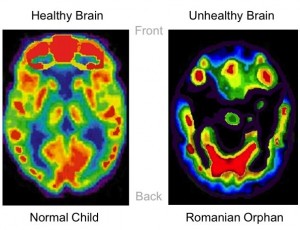
The most damaging source of stress for children is ongoing abuse and/or neglect. The Bucharest Early Intervention Project (BEIP) is a longitudinal study based on severely neglected Romanian orphans who were institutionalized from birth and later moved into nurturing homes. The study is outlined by Dr. Charles Nelson, a professor at the Harvard School of Public Health, in the following clip.
The Ecology of Childhood module includes updates on this research study.
Defining different types of stress activation can help caregivers understand that when children experience stress, the caregiver’s presence and support can help to reduce the negative impact on brain development. Review your understanding of the three types of stress activation:
There is no doubt that toxic stress can have devastating effects on children. Dr. Michael Yellow Bird, Dean of the Faculty of Social Work at the University of Manitoba, presents a practical and hopeful message about the “healing power” of some everyday experiences. He explains how traditional activities such as movement and dance affect our brains and alleviate stress. As you listen to the next two videos, think about what Dr. Yellow Bird’s message means to you and to children in your life.
Which of Dr. Yellow Bird’s messages resonate with you, and ways you can manage stress in your own life?
How can you apply his suggestions to your work with children?
On the next page, you will learn about memory and how researchers study it. Memory is an important aspect of thinking and learning.


