


1.2 Experience-based brain development
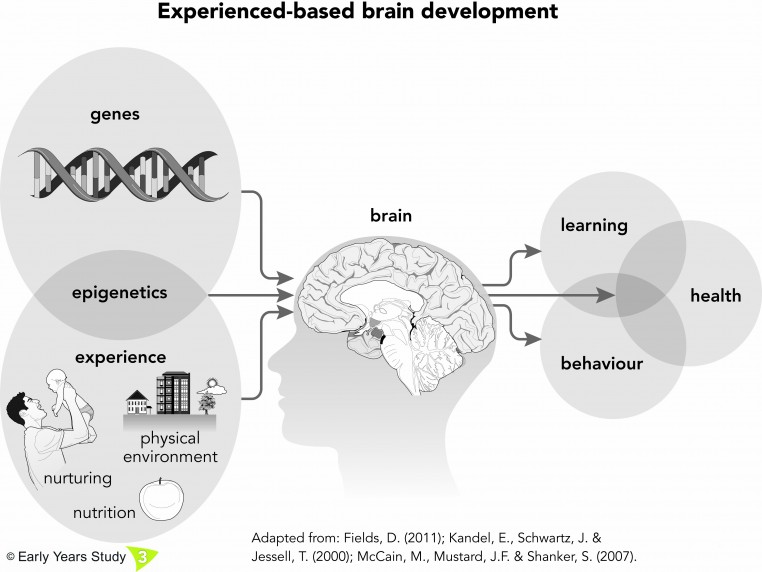
We have known for a long time that physical experiences such as nutrition are important for early brain development. We now understand that positive social interactions and nurturing environments are also very important.
Experience-based brain development is about the impact of daily experiences. Experiences and environments affect brain development, which shapes other biological pathways and ultimately affects learning, health and behaviour. It is clear that everyday experiences are extremely important, especially during the early years.
In the next video, Dr. Joel Levine, from the University of Toronto, explains the term experience-based brain development.
Listen to Dr. Rob Santos, a psychologist and research chair of the Early Childhood Development Research Team at Red River College Polytechnic, discuss early brain development and experience.
Santos discusses the importance of supporting pregnant women. In what ways could providing support to a pregnant woman influence brain development of the fetus?
Santos also says that that the social environment of the child is very important to early brain development. What does this mean? What do you think a supportive social environment looks like?
It is clear that brain development does not happen independent from one’s environment. In fact, there are two distinct ways that experiences impact brain development: experience-expectant and experience-dependent processes. Listen now as Dr. Maureen Black, a professor of Pediatrics at the University of Maryland, describes these two processes.
Dr. Charles Nelson describes interesting work that looked at a baby’s ability to recognize human and monkey faces at different ages. This is an example of experience guiding brain development in infancy. In the research section of this module, you will see more on how this research is done, with videos taken in Nelson’s lab.
Nature and nurture
Every child is unique; even two children of the same biological parents with upbringings that seem similar, can be very different from one another. In an attempt to explain this, people have debated the importance of nature (an individual’s genetic make-up) vs. nurture (environments and experiences) for years. Are genetic or environmental factors more important in determining child outcomes?
Dr. Marla Sokolowski explains that the phrase, “nature versus nurture” is no longer applicable to scientists’ understanding of how human beings develop.
Consider these examples of nature through nurture:
A child may have a genetic predisposition to burn when exposed to the sun. However, if that child lives in a climate with little sun exposure or always wears sunscreen and protective clothing, s/he likely will never have sunburn. This may then offer protection against skin cancer later in life.
Children may be genetically predisposed to be tall as adults. However, without proper nutrition through infancy and childhood, they may not reach their full growth potential.
Sensitive periods
In this KidCareCanada video Dr. Thomas Boyce starts by saying it is important to “…hold, talk and touch to babies…”. As he relates this to brain architecture, he introduces the concepts of critical and sensitive periods.

It is important to understand the concept of sensitive periods, especially when considering how to support healthy development. A sensitive period is a period of time in neural pathway development in which experience strongly influences how the pathway is constructed. The slide to the right illustrates this concept by showing how the formation of synapses for different neural pathways takes place at different times.
Consider…
Nathalie and Catherine are both two-year-old cousins. Nathalie is growing up in a busy francophone (French-speaking) household in rural Quebec – with grandparents, parents and five siblings – where French and a little English are used. Catherine lives in a similar Francophone household in Montreal, Canada, but unlike Nathalie, her family regularly uses both French and English.
Read moreWhy do you think Nathalie can only make French language sounds at age two while Catherine is speaking in both languages?
How does this example illustrate experience-based brain development?
What, if anything, does the children’s age have to do with it?
Do you have any experience with learning multiple languages? At what age were you exposed to the language(s) in which you are fluent?
The next clip shows seven-month-old Lucy being fed cereal by her mother.

How does Lucy’s mother show that she understands Lucy’s social signals? How does Lucy communicate?
What sensory pathways do you think are being stimulated? Check the slide above on sensitive periods. In what areas is Lucy especially ready to learn?
The evidence is clear that early child development is a period of opportunity to establish a sturdy brain foundation for later development. It is also a period of increased risk since there can be problems later on if the early foundation is not solid.
Use the flash cards below to review some key terms from this section before going to the next section in this module.


