


2.3 Literacy
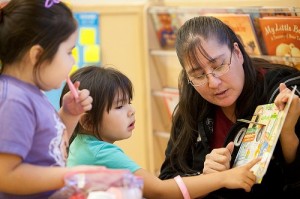
Speaking, listening, reading, storytelling, drawing and writing are all part of early literacy. Children discover the importance of these activities in communicating with others.
Children first learn to read – to connect sounds to print symbols – by building on their oral language. One of the most effective ways to introduce children to reading is through picture books. When adults – parents, other family members or educators – read to children, they expand children’s vocabulary, make the meaning of print visible to children and motivate children to learn through reading.
The two readings that follow are part of the research summary, Language and literacy: From birth for life. It was a joint project of the Canadian Child Care Federation and the Canadian Language and Literacy Research Network. The first reading reviews developmental milestones for infancy through age six and the second reviews evidence-based strategies for supporting language and literacy development.
Consider how the general principles in these reports apply to your work with children. In the language you work in, what are some common mistakes children make that show they are starting to understand grammar rules?
Listen as Dr. Janet Werker, from the University of British Columbia, describes some research looking into the question of whether early language development can predict later language and literacy abilities.
In the next video, Dr. Lillian Katz, professor emerita at the University of Illinois at Urbana-Champaign, explains the difference between having a skill and the disposition to use it. This is especially relevant for skills related to literacy and she describes the importance of helping children become enthusiastic about reading.
Family early literacy programs
Family literacy research points to the effectiveness of programs that work with parents, other caregivers and their children. Reading picture books and oral story-telling in a child’s home language increases the vocabulary children hear, builds a sense of narrative and introduces children to print communication.
As you will see in the next video, reading books can begin in infancy.

What does this parent do to help the baby connect with and understand the words in the book?
How can you tell this baby already has had lots of experience with book-reading?
What is the importance of the child sitting on the parent’s lap?
Watch the next two videos as a parent and child read a picture book together.


In each video, it is clear that the children are very familiar with these books. What difference does this make to their experience of being read to?
What does each parent do to encourage their child’s developing language abilities?
Why do children like to hear the same stories and read the same books again and again?
In the next video from Tajikistan you will see a father and daughter reading together and then the father explaining the importance of books.
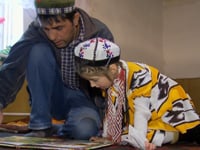
Access to good storybooks can be a challenge for families. Reading for Children is a program that provides a lending library and encourages family members to spend time reading with their young children in a way that makes it not only enjoyable but stimulates conversations and learning. The following video highlights the Reading for Children program in rural areas in Kyrgyzstan.

The Aga Khan Development Network has provided an overview of the Reading for Children initiative and its progress from 2007-2015.
Dr. Janette Pelletier, professor emerita of Applied Psychology and Human Development at the Dr. Eric Jackman Institute of Child Study at the University of Toronto, has been researching programs that support early literacy. In the following clip, she explains a program that brought parents into Kindergarten with their children.
In the next clip, Pelletier describes the short and longer term effects of the Parents in Kindergarten program on the children.
Pelletier mentions several factors that influenced results including parent income and the timing of program entry. Why were these important?
Can you see any connections between this study and the Hart and Risley study (on p. 2.1)?
Pelletier goes on to describe another study called the Family Literacy Project – a larger study that also involves many families from diverse language backgrounds.
In the next two clips she discusses some early findings from the Family Literacy Project.
How does the finding about the effectiveness of the personalized alphabet books fit with what you know about how young children learn?
Why is a program such as this an effective investment in early child development?
Literacy instruction
Educators around the world often debate the best way to teach children to read. Studies from affluent and low-income countries demonstrate success of early reading programs that focus on BOTH the structure of print and what print means (Bartlett, 2010).
Once children are able to read, they start to read to learn – reading is a tool to access information about the world and how it works. Decoding print is one important element, but to make the jump from learning to read to reading to learn, children need to understand what the words mean. When children are able to read to learn they have a powerful tool.
A strong vocabulary and a print environment are powerful starting points, but few children acquire reading skills without systematic instruction.
Dr. Noralou Roos, founder of the Manitoba Centre for Health Policy at the University of Manitoba, describes a program that provides additional reading instruction to children identified by their teachers as not yet reading at the appropriate grade level. The research results are quite promising.
Reading to Learn is a literacy-teaching program designed to enable all learners to read and write successfully, at levels appropriate to their age, grade and area of study. The teaching strategies have been consistently and independently evaluated to accelerate the learning of all students from twice to more than four times the expected rates, across all schools and classes, and among students from all backgrounds and ability ranges. Watch the next video and see how the Reading to Learn program is being used in Afghanistan.

The program, intended to integrate reading and writing with the teaching curriculum at all year levels, has been developed over ten years with teachers of primary, secondary and tertiary students across Australia and internationally. The strategies apply research in classroom learning, and language across the curriculum, in a form that is accessible, practical and meets the needs of teachers and students.
Check out the following website for more information about the Reading to Learn literacy program.
How important is technology in helping children develop language and literacy? The Encyclopedia on Early Child Development (2016) provides a synthesis of research findings on this topic, with a specific focus on ebooks and educational apps designed to support language and literacy. Read the synthesis to learn more about this topic. The second document highlights the same research findings, but is formatted for parent use.
This is an ever-changing area of study, with an ongoing need for research. At this point, what do we know?
What are the implications for supporting children’s language and literacy?
What are your research questions?


