


2.4 Executive function
Consider…
When four-year old Malik arrives in his preschool, he finds a spot and sits next to his friends on the mat. The teacher greets everyone… Read more
What kind of regulatory skills do you see Malik demonstrating?
How do these skills help Malik adjust to school – socially and in terms of learning?
How might Malik behave differently if he didn’t have these skills?

Malik is demonstrating an interrelated set of regulatory skills known as executive function. We continue to develop executive function skills throughout life.
Mastery of executive function skills help us regulate our emotions, behaviour and attention and ultimately reach our goals.
Executive function includes:
- Inhibitory control – ability to stay on task, inhibit impulsive actions and pay attention
- Working memory – ability to hold information in mind and recall for use later
- Mental flexibility – ability to modify plans and try different strategies to find solutions
The following video from the Harvard Center for the Developing Child provides an overview of executive function and explains how executive function skills help prepare children to cope well in school and in life.
Now read some information from the website on executive function and child development. Explore the second resource that provides practical examples about ways to promote executive function skills for various ages of children.
Dr. Philip Zelazo, a developmental psychologist and neuroscientist from the Institute of Child Development at the University of Minnesota, describes what is meant by the term executive function, how it relates to self-regulation and elaborates on the three processes involved.
Differences in executive function explain why some children seem much more ready for school – to listen, to show some independence, to be able to complete a task – than others. In the following clip, Zelazo explains that executive function is a key developmental outcome.
Executive function can easily be observed in many daily tasks and interactions in children’s daily lives. As you watch the next video, consider the child’s ability to stay on task and the various ways his attention is being challenged.

As you observed the child building the tower, what did you notice about his inhibitory control? What did he do to stay on task?
What did you notice about his mental flexibility? How did he modify his plans when the structures fell down?
The next short video shows a child mastering matching numbers on a small game device.
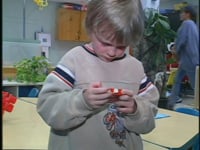
How was this child demonstrating executive function skills?
What was the adult’s role and why is it important?
The following article from the Center on the Developing Child (2011) uses the following comparison, “having executive function in the brain is like having an air traffic control system at a busy airport to manage the arrivals and departures of dozens of planes on multiple runways.” (p. 1).
In the next clips, Zelazo describes the emergence of executive function and how it is measured by researchers during infancy and the preschool years.
Dr. Jo-Anne LeFevre, director of the Institute of Cognitive Science at Carleton University, provides another example of how children’s spatial attention or working memory can be measured.
Executive function and brain development
Executive function is orchestrated by the brain’s prefrontal cortex (PFC – the cerebral cortex covering the front part of the frontal lobe) with neural pathways connected to the limbic system. In the next two videos, Dr. Bryan Kolb, from the Canadian Centre for Behavioural Neuroscience at the University of Lethbridge, explains how play affects brain development and the role of the PFC and the frontal lobe.
Dr. Megan Gunnar, former director of the Institute of Child Development at the University of Minnesota, discusses findings from the Bucharest studies (see Ecology of Childhood module, 2.2 Early child development programs for more information) that relate to children’s long-term attention abilities. Gunnar points out the impact of early adversity on brain development and later attention regulation.
Supporting executive function
Adults can encourage and support the development of executive function in children but, as Zelazo explains below, it is important that they understand it develops gradually.
How does understanding some of the brain development behind executive function influence your understanding of children who struggle with tasks that demand executive function skills?
How is executive function related to a child’s self-regulation of behaviour and emotions?
How can adults scaffold a child’s ability to pay attention?
How does pretend play help children’s executive function skills?
Mindfulness
Recently, a state of being called “mindfulness” has become prevalent in education as well as in popular culture. Mindfulness means staying calm and focused in the moment and not being judgmental of your reactions – rather like the “calmly focused and alert” state described by Shanker on p. 1.1 of this module. In this next video, Gunnar describes new research related to mindfulness and its effect on children’s abilities to attend.
Can you describe some activities that would help preschool children practice mindfulness?

Does teaching children mindfulness techniques, such as sitting still and focusing on their breath, really make a difference? Dr. Kimberly Shonert-Reichl is the NoVo Foundation Endowed Chair in Social and Emotional Learning and Professor in the Department of Psychology at the University of Illinois at Chicago; Former Applied Developmental Psychologist and a Professor in the Human Development, Learning, and Culture area in the Department of Educational and Counselling Psychology, and Special Education at the University of British Columbia (UBC); and the Former Director of the Human Early Learning Partnership (HELP) in the School of Population and Public Health in the Faculty of Medicine at UBC. In the next video, Dr. Shonert-Reichl describes the Wave 6 results in British Columbia as well as her research on mindfulness with school-age children and kindergarten children.
What are the positive effects of mindfulness training on school-age children?
How might increased mindfulness help children improve executive function?
Can you describe some activities that would help preschool children practice mindfulness?
Mindfulness is a very popular topic in education, health and business circles as well as in popular culture these days. What societal factors may contribute to that?
Schonert-Reichl goes on to discuss how you can actually teach mindfulness to children and the importance of adult states of mindfulness in relating to children.
Lying and executive function
Dr. Kang Lee, from the Dr. Eric Jackman Institute of Child Study at the University of Toronto, studies the development of lying throughout childhood. He also does cross-cultural comparisons that highlight how different cultures view lying and situations in which it is considered acceptable. In the next videos, Lee explains some of his research and the connection between the development of lying and executive function.
Lee explains that a young child who lies is demonstrating executive function and perspective-taking. Will this influence how you respond to a child who is lying?
How does your culture handle lying and when is lying considered an appropriate response?
Dr. Lee explains another type of motivation for lying when individuals or groups lie for the sake of a group.


