


2.3 The economic impact
Investing in young children through ECD programs is one of the smartest investments a country can make to address inequality, break the cycle of poverty, and improve outcomes later in life” (World Bank Group, n.d.).
The Early Years Study 4 (McCain, 2020) provides compelling data showing the important role early childhood education can have in children’s lives. Chapter 3 – “A step up for all: ECE helps kids, families and communities thrive” – makes a strong case.
Were any of the statistics new or surprising?
What role can early childhood education and care play to address inequality?
Economic evidence makes a powerful argument for investing in early childhood. In the next video, Craig Alexander, former vice-president of economic analysis for the C.D. Howe Institute, discusses some of the research that points to early childhood education as an important investment for children, parents, the economy and society.
Can you see how early childhood education programs economically benefit families where you live?
Dr. James Heckman, a Nobel prize-winner in economics, and his colleague Dr. Flavio Cunha show us that investments in early childhood programs make good sense based on the returns provided to society as a whole. Each stage of life underpins the next. As the slide to the right shows, investment in the foundation stage of early childhood provides a higher rate of return than investments later in life.
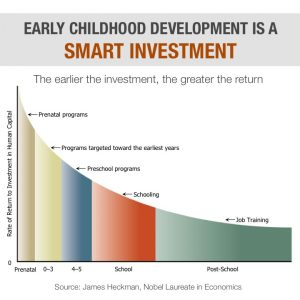
In The economics of inequality: The value of early childhood education (2011), Heckman describes four conclusions from analyses of long-term studies on human development:
1. Inequality in early life leads to inequality later in life for achievement, health and success.
2. Social skills are as important as cognitive skills for impacting lifelong success and therefore should not be neglected.
3. Investing in early childhood education has the potential to help people overcome disadvantages.
4. The long-term economic savings are great for investments in early education. This is especially true when investments are made for disadvantaged children.
Dr. Mildred Warner, a professor in the Department of City and Regional Planning at Cornell University, studies the economics of child care. Here she discusses how investing in early child development benefits children, families and the business community.
The links to practice section in this module looks at how to use this information along with other developmental health concepts to promote programs and policies focused on getting all children off to a healthy start.


