


1.2 Growing up in poverty
The test of our progress is not whether we add more to the abundance of those who have much; it is whether we provide enough for those who have too little
Franklin D. Roosevelt (Franklin D. Roosevelt Presidential Library & Museum. (n.d.).
How does poverty fit into the developmental health perspective?
Are children from families and communities with fewer resources destined to have poorer outcomes in health, learning and behaviour? We all know of examples in which that is not so.
At the same time, clearly, all over the world, poverty interferes with children’s rights to health, and well-being. Good conditions early in life set a strong foundation for what’s to follow. Clearly poverty can hinder children’s future capacity to be strong, healthy adults who fully participate in life.
A view of the world from space is beautiful. We all live on one planet but with many different realities that influence our lives and well-being. For many people, the different realities mean stark differences in long-term health, learning opportunities and well-being.
Why is it that some people and populations experience deprivation and extreme hardship while others do not?
Dr. Zulfiqar Bhutta, founding director at the Centre of Excellence in Women and Child Health, at the Aga Khan University, often uses an image of earth to begin a discussion on the disparities and inequalities of our world. Listen as he explains the metaphor.
Clearly, poverty can be a major factor in jeopardizing children’s future capacity to be strong, healthy adults, able to fully participate in life.
How is Canada doing in terms of child poverty? UNICEF published a report card on child well-being in the richest countries which shows that Canada continues to rank poorly in comparison with peer countries. The 2018 UNICEF Report Card places Canada 26th out of 35 nations showing there is a significant inequality gap.
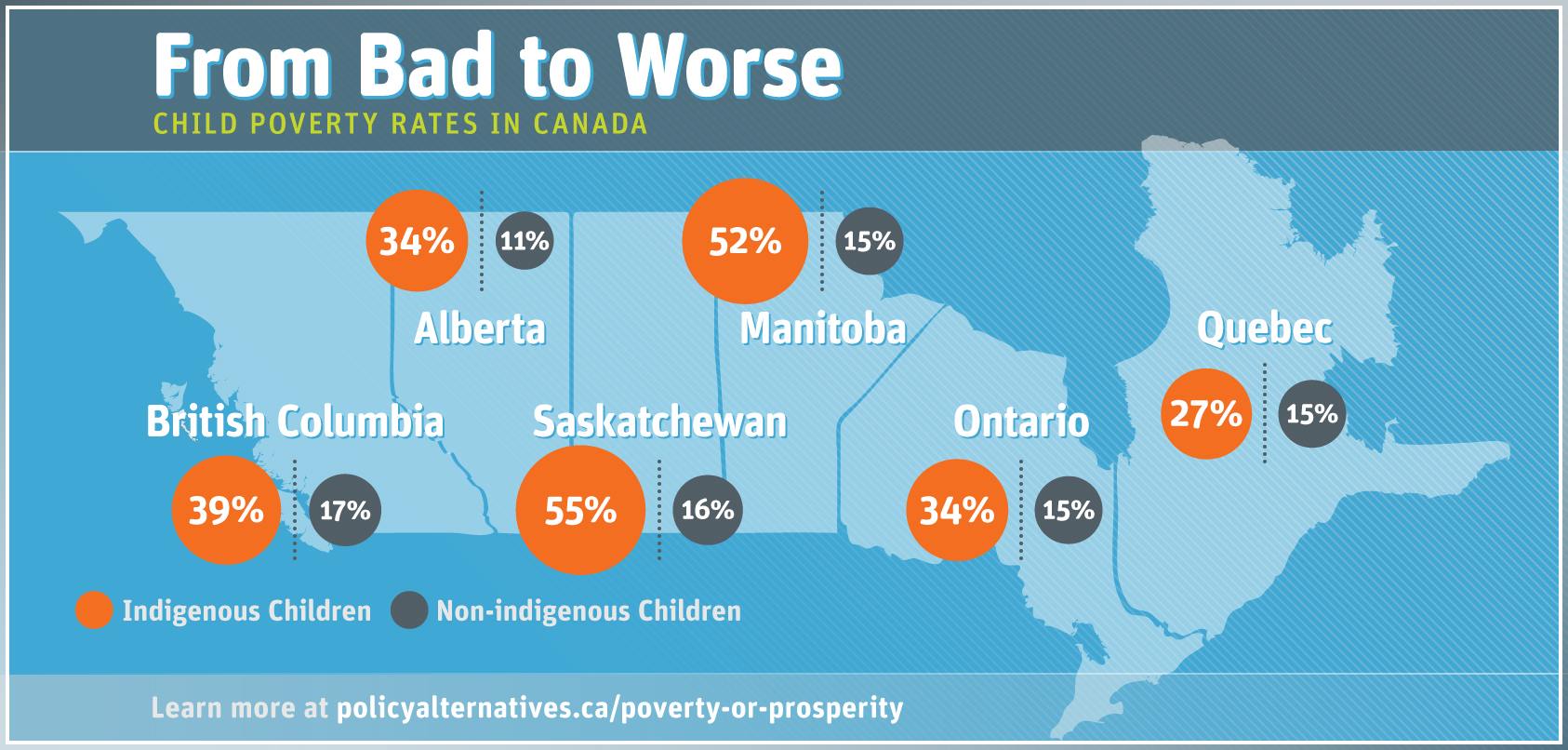
The high level of poverty among Indigenous children in Canada has been a national disgrace for decades. Indigenous children are twice as likely to be living in poverty than their non-Indigenous counterparts with the rate climbing to 60% of all children on reserves. The following graphic comes from a 2016 report by the Canadian Centre for Policy Alternatives, ‘Shameful Neglect: Indigenous Child Poverty in Canada”.
Denny and Brownell (2010) explain that conditions associated with poverty can mean that children in lower socioeconomic (SES) groups can have a higher allostatic load (accumulation of stressful experiences that can have a negative effect on physiology) than those in higher SES groups. Consider how a child would be affected by things like: inadequate housing, food insecurity, limited access to nutritious fresh food, exposure to toxins, limited access to libraries and cultural activities, exposure to violence in the community, family turmoil and chaotic routines. It is not hard to understand how these conditions would be problematic.
In the next video, Dr. Noralou Roos, founder of the Manitoba Centre for Health Policy at the University of Manitoba, discusses how income disparity affects health. She ends by comparing the impacts of cancer and low-income on life expectancy.
Roos mentions that the negative effects of poverty on children’s health seem to be more apparent in the first few years and then again in adolescence – but not so much between ages 4 and 11. What might be some reasons for this?
Were you surprised by the finding in the Duke University study that poverty has more effect on life expectancy than the risk of cancer? Why might this be?
It is important to think carefully about what constitutes child poverty. Does a family’s income alone determine whether children are growing up in poverty or are there other factors that are equally, if not more important? What might these be – and more importantly, what kinds of supports are most effective in supporting child development in contexts where material resources are limited? Why, with limited material resources, do some families and communities do well while others do not?
Enjoy the following video as three young children in Bangladesh introduce us to their village, families and early child development programs. As you watch the video, consider how the developmental health of the children as well as the community is being supported.

In what ways do the ECCD programs in the video contribute to children’s well-being?
What do you think are some of the aspects of these programs that have contributed to their success?
How might the programs benefit the village?
The report, The long reach of early childhood poverty (Duncan & Magnusson, 2011) summarizes what is known about the experience of early life poverty on later outcomes. Here are some highlights from that reading:
- The long reach of early childhood poverty – adults do more poorly in the workforce when they experienced poverty early in childhood vs. later in childhood.
- Poverty is problematic because it affects so many things in a family’s life, for example, neighbourhood safety, parents’ ability to provide learning opportunities, parents’ psychological distress and conflict, and the availability of quality child care.
- Poverty affects brain development when it means the child receives fewer serve-and-return interactions, has fewer learning resources and is exposed to toxic stress.
- Interventions to reduce the negative effects of poverty should address income issues directly as well as child and parent supports.


