


3.1 Sustaining home life
Families are central to the lives of children. Regardless of how children join their family, through birth, foster placement, adoption, intergenerational caregiving, or step-parenting, all new parents can experience a period of adjustment – physically, emotionally and cognitively. The often-daunting task of parenting can include many joys and challenges as parents navigate their new role. While parents certainly hold a large portion of responsibilities for their children, there are broader societal responsibilities for optimizing high quality child development that need to be considered. Community programs that support parenting, social policy that supports optimizing children’s full potential, and inclusion practice that considers the diverse socio-cultural contexts of all children and families can have a lasting effect on children’s developmental trajectories.
The late Dr. Alan Mirabelli, former executive director, explains how the vision of the Vanier Institute of the Family supports children, families and society.
Alan Mirabelli discusses the need for a society to value parents and families. Can you think of examples that demonstrate whether, as a society, we see the role of parents and families as important?
Considering all families
Every family is unique. Even families with similarities will have their own unique customs and traditions that make them who they are. To truly support families in their social contexts, those who work with them need to be aware of each family’s uniqueness by getting to know them, considering how to make each family feel they belong, and ensuring they are meaningfully represented and heard.
Listen to Dr. Shelly Mehta, professor and coordinator at the School of Early Childhood at George Brown College as she describes providing children and families a sense of belonging by ensuring their voices are amplified and heard.
1. Race
The concept of race is complex. The American Psychological Association (2024) states, “Race refers to the social construction and categorization of people based on perceived shared physical traits” (para 1). It is only one of the many aspects that makes up a socio-cultural identity.
To see how race and other socio-cultural identities can impact a family’s experiences, read about Rosetta, Ian, and Christopher as newcomers to Canada.
Christopher is a 6-year-old child attending an elementary school in Acton, Ontario… Read more
In this scenario, Christopher and Rosetta are singled out to represent a social identity they do not belong to simply because of their race. How do you think this makes Rosetta feel?
How can you avoid asking individuals to represent a social context they do not belong to?
Recall the definition of intersectionality in the Ecology of Childhood (EC) module, page 1.1. Can you see how Rosetta, Ian, and Christopher’s social factors have led to prejudice and oppression?
One way to work towards inclusiveness and belonging for children and their families is to begin to understand the impacts of the day-to-day experiences that may often go unnoticed or unrecognized. Recall the information on intersectionality in EC 1.1 that describes intersecting social categories that impact the lives of families. Racialized families with intersectional identities (race, gender, sexuality, ability, etc.) often hear and feel comments or thoughts that, upon closer inspection, are insulting. These are called microaggressions. Microaggressions can be unintentional as they tend to come from unconscious bias. You can explore different types of microaggressions in the following link. Once you become aware of microaggressions, you can avoid using them.
Recall the story of Rosetta, Ian and Christopher. What are some examples of microaggressions that Rosetta, Ian and Christopher have experienced?
What are some ways these microaggressions could have been prevented?
2. Anatomy, physiology, gender and sexuality
Anatomy, physiology, gender, and sexuality are complex concepts of socio-cultural identity. The language surrounding these concepts is important for everyone to know and understand so children and their families can be supported. Children develop at a rapid pace, including their language and identity development. When they do not see themselves or hear words that represent them, they make up words, struggle to fit in, and may not feel they belong. (Pastel, et al., 2019).
Shailja Jain, Professor at the School of Early Childhood at George Brown College, and PhD candidate, is researching gender justice, in particular gender expansiveness and gender affirmation within the early childhood context. In the video below, Jain talks about the importance of inclusive spaces in classrooms when supporting families.
The generalized acronym for gender and sexuality variations, 2SLGBTQIA+ (Two Spirit, Lesbian, Gay, Transgender, Queer, Intersex, Asexual or Ace, plus), has evolved over time. This acronym uses a selection of terminology, hence the +, meant to include everyone. Vocabulary is constantly being modified as contexts and experiences of individuals change. Individuals should determine the language used to describe themselves.
The link below provides vocabulary with descriptions to help us understand the nuances of each vocabulary term. Remember that language is evolving and changing, yet personal for each individual.
What terms are you familiar with? Are any new to you?
What term(s) can you use to identify yourself?
Children have a right to explore their gender in a welcoming, warm and supportive environment without adult pressure. In the following video, Jain outlines how educators can embed gender affirming care for children and families. Jain advocates taking a gender justice approach that supports children’s gender agency, gender diversity, and gender health, suggesting that affirming identity in simple ways can make a big difference.
Consider the concept of gender affirming care when you read the following.
Jamal is a 5-year-old Kindergartner at Centreville Childcare Centre in Centreville, New Brunswick… Read more
What are some ways that Ana and other educators can ensure that spaces are inclusive and safe for all children?
In what ways can Ana support Rashad’s wishes while considering the biases and fears that Rashad has?
Supporting families
What do parents want and need to provide the best possible home base for their children?
Dr. Carl Corter, professor emeritus of Applied Psychology and Human Development at the University of Toronto, explains that parents need and want both tangible and intangible supports. Tangible supports include services that enhance the community, like libraries and playgrounds. Intangible supports include positive, respectful relationships between parents and the professionals who work with children.
He also gives examples of intangible parenting supports when he explains that parents want their society to view the parenting role as important. Parents also want input into the design and implementation of early years programs and services.
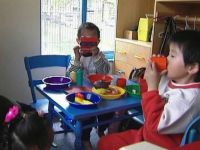
As you watch the following clip from the video, Family Resource Programs: Supporting the Early Years, enjoy the images of children having fun together, playing and learning, and the sense of well-being that is exuded by both children and parents in this setting.
What are the elements of family resource programs that support child development?
What elements support parents?
The next clip tells the story of a young single mother who is struggling to find housing in an expensive city and how the family resource program community helps.

What kind of impact do you think the family resource program is having on the lives of this mother and child?
What if there had been no such program in her neighbourhood -what might have happened?
Early childhood programs
What are some of the ways early childhood programs can support children’s home environments?
In the following video, learn about one mother’s experiences with the caregivers at her child’s centre.

In what ways does this mother find the centre supportive?
How do you think a trust relationship between parent and educator was developed?
Besides in-person programs and services, there are other ways to support parents and provide information and resources. Online resources are especially important for those who cannot access in-person sessions. One such resource is MyBaby, a free, online resource that sends evidence-based video messages that demonstrate and explain positive parenting practices. The content also is a useful tool for professionals involved in parent education, home-visiting, and other parent support initiatives. Explore the MyBaby website and click on the featured topic of the week to see an example.
Consider how a resource like MyBaby addresses Corter’s point that parents of infants can feel that society doesn’t support or value the hard work of parenting.
Corter goes on to explain how early childhood educators can best support parents, by respecting them.
In the next two clips, Corter points out that some parents need extra efforts.
Dr. Zeenat Janmohamed, academic chair of the School of Social and Community Services at George Brown College, discusses that early childhood educators’ support to same-sex families can be particularly important if those families do not feel supported by their own extended families.
Parents and other primary caregivers bring intimate knowledge about each child and his or her cultural context. They also learn from others and expand their own parenting/care giving capacity. Environments can be structured to invite participation by parents and caregivers.
Pat Furman, executive director of Inspired by Wonder, reflects on the range of ways staff build relationships with parents.
Pat Furman highlights more than a broad array of activities or events – she outlines a well thought out process that is grounded in respect for families. How is this evident? Why is this important?
It is always inspiring to hear new ideas. Are there any that you think might be suitable in your work with families?
Sometimes there are excellent programs – but they do not reach all who need them. The late Dr. Clyde Hertzman, founding director of the Human Early Learning Program (HELP) at the University of British Columbia, discusses some common barriers that prevent access.
Corter emphasized that “families come first in terms of the influence that they have on a child’s development”. However, how many have heard the phrase “It takes a village to raise a child”? Parents need and deserve recognition, respect and support as they raise children. Family resource programs and early childhood programs offer an early opportunity to connect with parents and support their competencies and confidence.
Early child development programs are an important part of many children’s daily lives. The next page explores ways to strengthen these important environments.


