


3.3 Creating child-friendly communities
Consider…
Barnes Early Childhood Centre
Barnes Street Early Childhood Centre located in downtown Toronto is on the ground floor of a large high rise condominium… Read more
What do you think “it takes a child to raise a village” means?
What public policies do you think set the stage for the informal connections families made with each other?
What are the longer-term implications for these children?

The daily lives of Canada’s young children and their families reflect larger social and economic changes taking place in Canada and beyond. Most Canadian families live in urban settings – from small towns like Neepawa, Manitoba to big cities like Calgary, Alberta. Parents may leave their community for extensive periods of time to seek employment far way from home or to participate in the military. For most families with only one income, and even those with two incomes, it can be challenging to remain above the poverty line. Extended family members often live far away but stay in touch in ways not possible in the past. Online communication and inexpensive telephone plans make weekly and even daily contact possible in spite of geographic separations.
Canada is an extremely socially diverse country with Indigenous peoples, a large French-speaking minority and many people from other parts of the globe. Twenty percent of Canada’s 35 million people were born elsewhere, mostly from Asia, Africa, Latin America and the Middle East (Global Centre for Pluralism, 2017). Consider the examples of different populations shown in the next video about Family Resource Programs. These communities are very diverse but hold some common values.

Why is it important for communities to have centres where all people can fit in and feel welcome?
How does this benefit children?
The program implies that all communities, no matter what the social or economic makeup, benefit from centres such as family resource programs. What do you think?
The lives of Canadian families may be very different from 100 or 150 years ago. But what children need remains the same. Parents and families are central and parenting is a learned skill. The demands of raising children often compete with those of work inside and outside of the home, causing intense pressure for many families. Community can play an important role. When parents receive help and support from their communities, families are strengthened and young children benefit from opportunities to play and learn with other children.
The late Alan Mirabelli discusses the roles and responsibilities of families and communities.
Have you looked around a public space in your neighbourhood on Saturday morning? Are children around? What are they doing? Who are they with?
In late spring as days become longer and warmer, are children in local parks and schoolyards in the early evening during the week?
Why does the focus tend to be on “street-proofing” children rather than making communities “child-ready”?
Dr. Paul Kershaw, a policy professor at the University of British Columbia School of Population and Public Health, outlines how communities influence health and well-being throughout life. He points out that support to adults who are raising young children is an important part of how communities nurture young children.
 Engaging communities
Child-friendly communities are ones that value childhood and parenting and build a web of support for families. Without a community web, parenting becomes more difficult and challenging. Government policies that favour shared public places for children and families set the stage. Community innovators can energize local citizens to pull together and make livable spaces for families particularly if public assets like parks, libraries and school buildings are available.
Family Resource Programs (FRPs) bring together children, parents and other caregivers in neighbourhoods and communities across Canada. Many are attached to schools, community centres, child care centres, community or public health programs. They decrease isolation, bring families together informally with outstanding benefits for children and parents. FRPs are shared public spaces that bolster a community’s capacity to be child-friendly.
In Canada, most new parents are eligible for one-year parental leave and benefits. Increasing numbers of new Canadian parents are taking advantage of longer time from work after the birth or adoption of a baby. FRPs provide a welcome resource for many new parents.
Family Resource Programs (FRPs) may be called family resource centres or have other specific names. For example, in British Columbia, Strong Starts are FRPs operated by school districts and located in elementary schools. In Ontario, Parenting and Family Literacy Centres are FRPs in schools.
The following video shows how FRPs support families and babies in very different communities across Canada.
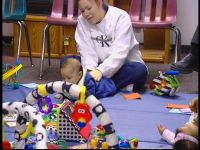
What do you think are the central messages of this video?
The video shows that FRPs are highly used and valued in many kinds of neighbourhoods. Families and other caregivers are welcome to “drop-in”. What are the advantages of this as opposed to programs that require advance registration or target specific types of families?
How do FRPs contribute to community life and social networks that extend beyond the program itself?
An important part of creating child and family friendly communities relates to respecting culture.
Stephanie Mikki Adams is the executive director of Inuuqatigiit, the Centre for Inuit Children, Youth and Families in Ottawa. In the first video she describes the role this centre plays in helping families navigate a new community and culture. In the second video she explains the important role of elders in Inuit culture.
On the previous page, Beatrice Alvarez described the way Inuit culture is reflected in the activities and programming at the Tumiralaat Child Care Centre. In this next video, learn more about the child care centre as an important part of the Inuuqatigiit Centre.
What are some of the ways the Inuuqatigiit Centre and Tumiralaat Child Care Centre serve Inuit families in an urban centre? How do they support Inuit culture and language?
Think about other families that may need help navigating a new community and culture. This might be families moving from rural to urban settings. Or it may be refugee families fleeing their home country and settling in a Canadian city. What programs and services are you aware of for these families?
Dr. David Butler-Jones discusses how local decision-making in communities can increase community engagement. He points out that in First Nations communities that have acquired more authority to govern, the youth suicide rate is much lower compared to other communities who have less control over their local environment.
How can community decision-making be guided by community wisdom and outside expertise?
Can you think of any examples of local decision-making in your community?
What skill does Butler-Jones identify as critical to working with communities to increase engagement and local decision-making?
Avenir d’enfants was an initiative in Quebec that mobilized communities to improve outcomes for young children from 2009 until 2020. Avenir d’enfants projects were initiated through community engagement, that brought people together to promote the development of children aged five and under, particularly those living in poverty. The next reading, Avenir d’enfants, mobilizing to improve outcomes for young children in Quebec from the Early Years Study 3 (McCain, et al., 2011, pages 57 – 60) provides a summary of the program.
Over a period of 10 years, Avenir d’enfants supported close to 3000 partner organizations, 16 regional committees, 139 local groups of partners, and 25 First Nations communities as they planned and provided projects to better the lives of children in their communities. According to the project summary report, “….the capacity of the groups supported by Avenir d’enfants for acting together has strengthened considerably over time, evolving from a more networking- focused dynamic reliant on information exchange and product coordination to genuinely collaborative work practices” (Clément et al., 2019, p. 3).
Try the following game to review some concepts discussed in this module.
The next video is an excerpt from The Beginning of Life documentary. It highlights important messages that have been explored throughout the Ecology module. Listen to why every child needs a community.

You have reached the end of the Ecology of Childhood Module. Researcher transcripts, references, and links related to the module topics are available on the next page.


