


6. Understanding play
On this page we learn about different kinds of play and why play is critically important for young children.
Think about your childhood…. what memories do you have of play? What was your favourite kind of play? Who was involved? Why did you like it so much? What do you think you learned from it?
Play is simply what children do – how they learn about the world around them, develop skills, create imaginary worlds, make friends, and discover all kinds of new and interesting things. Play also enables children to problem-solve, to develop a repertoire of flexible responses to situations they create and encounter, to develop self-regulation, and learn to overcome day-to-day challenges.
Watch the following video of children from around the world playing outdoors.

What are some words you would use to describe the play you saw in that video?
Did the play seem to be mostly child-led or adult-led?
What did you think about the play materials they were using?
Do you think these play experiences were important for the children? Why or why not?
We’ve all played – and we tend to think we know what play is. But actually, play is a complex and broad concept which experts have struggled to define. When educators talk about play they refer to things such as a child exploring, being actively engaged in voluntary activities, interacting with others and/or with materials.
In order to better understand play, it is useful to consider different categories based on the stage of play and the social context in which the play happens. In both cases, the groundwork was done decades ago but the information is still valuable today.
Sara Smilansky (1968) explained that theorists consider the development of play as happening in stages, through which children advance naturally, as they develop. She outlined four stages of play and pointed out that, “the stages overlap to a great extent, and some play behaviors continue parallel to others and in interaction with them even into adulthood. At any given time, however, one stage of play appears as most prominent” (Smilansky, 1968, p. 5).
Mildren Parten (1932) observed preschool children at play in a nursery setting to consider their social participation. She outlined categories of social play that consider the nature and extent of a child’s involvement with others. Note: it can be argued that the first two categories (unoccupied and onlooker) are not actually types of play since the children are not actively playing.
See how you do on this review game on the stages and social categories of play.
The importance of play
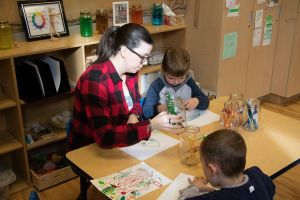
This is another key concept for working with young children. Without an understanding of how children develop and learn, it would be easy to think of play as just for fun and not that important. However, play is fundamentally important to children’s growth and development. This is recognized by the Lego Foundation which has been developed to support and advocate for play around the world.
Explore the pages below on the Lego Foundation website.
Young children not only learn best through play; they also find ways to deal with fears, anger, and other strong emotions. Between the ages of one and six, play is the main way children interact with the world. If children do not have enough time, space, and opportunity for play, they cannot develop optimally. Long, uninterrupted free periods allow children to experience more satisfying and interesting play. If a play period is brief, children may just run around but with longer opportunities,, they can get involved in higher level play such as cooperative, imaginative games or complicated construction projects. That kind of play is joyful, satisfying, and essential for children.
The website below from Harvard Centre for the Developing Child shows how play supports brain development and provides suggestions for different play activities at different ages.
As you watch the next four videos, note the styles and categories of play that you see. The first video shows babies and caregivers enjoying play in a child care centre.

The next video shows a group of preschool children in a child care program in Winnipeg. Five-year-old Jordyne has invented a rather elaborate game that involves all the children taking turns blowing bubbles and keeping a record using chalk on a stump. The children range in age from 2 to 5.

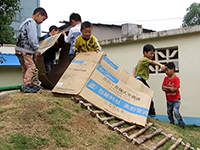
Now watch a different kind of outdoor play involving a group of preschoolers in Anji, China.
The next clip shows some children in a Madrasa preschool in Pemba, Zanzibar playing with bottle caps.

- What are the styles and functions of play you saw in these videos?
- How were adults involved in the play – or not? (Consider both direct and indirect involvement).
Now test your recall with the following review quiz.
You have reached the end of this module.


