
Prenatal Neurological Development
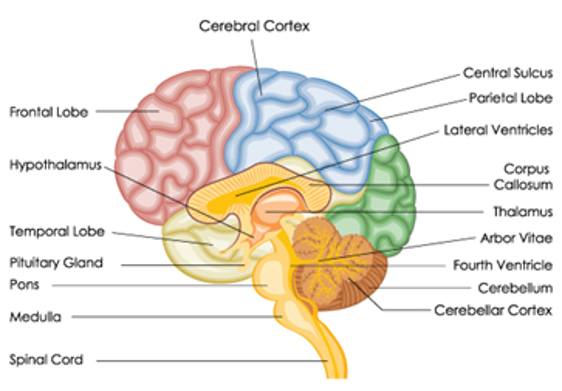
Developing Nervous System
- In week three following conception, the nervous system has its origins in the ectoderm (one of three germ layers).
- In the fifth week following conception, more flexures in the neural tube create three distinct areas of the brain.
- In the forebrain, development of both cerebral hemispheres as well as the thalamus (which relays motor and sensory signals to the cerebral cortex) occurs. The entire cerebral cortex will continue to develop throughout the rest of gestation and into childhood. The eyes and olfactory system (sense of smell) also develop from the forebrain during fetal life.
- From the midbrain, cranial nerve III (oculomotor) and IV (trochlear) are formed.
- From the hindbrain, the medulla, pons, and cerebellum develop.
- In week eight, there have been recordings of brain waves.
- In weeks 11–12 there are arm and leg movements, position changes and practice breathing movements.
- Even after organs have been formed, damage to the nervous system from fetal or newborn stressors such as infection, lack of oxygen, poor nutrition, and drugs is still possible and can result in developmental delays or learning disabilities, among other potential outcomes.
Developing Senses
- By 24 weeks, response to sound is apparent. The ability to become accustomed to repeated sounds over time will also develop. A mother’s voice can be soothing for a fetus. At birth, hearing is fully developed.
- Taste differences can be distinguished with evidence showing more rapid fetal swallowing by the fifth month when sweetener is added to amniotic fluid.
- By the seventh month, rods and cones are present in the retina of the eye. Evidence of fetal vision includes sudden fetal movements when a bright light is shone on the mother’s abdomen in later pregnancy. Similar to children and adults when dreaming, rapid eye movements have been observed during sleep.
Reference
Keenan-Lindsay, L. (2022). Genetics, conception, and fetal development. In L. Keenan-Lindsay, C. A. Sams, & C. L. O’Connor (Eds.), Perry’s maternal child nursing care in Canada (3rd ed., pp. 149–174). Elsevier.

