
Prenatal environmental influences
Stage of Development
Time Period
Summary and Highlights
Pre-embryonic

From fertilization through the initial two weeks of development.
- Cells multiply and differentiate rapidly.
- Fertilization and implantation occur.
- Other structures outside the embryo that nourish and protect it begin to develop.
Embryonic

From the beginning of the third week through to the end of the eighth week of development.
- This is a critical period for organ development.
- Initial cardiovascular and central nervous systems develop.
- Inner and outer structures develop.
Fetal

From the beginning of the ninth week through to the end of gestation.
- Rapid growth and weight gain.
- As the complexity of structures increases, body systems also become more operational.
Source consulted: Ward & Hisley, 2009
During pregnancy, expectant parents often focus on how to ensure healthy outcomes for their baby’s birth and their child’s developmental course throughout life. Fortunately, the developing embryo and then fetus is usually in a warm environment where it can be well nourished and safe from many hazards while it continues to grow and develop. There are, however, various influences that can have a negative impact on prenatal development.
According to the Gale Encyclopedia of Medicine (2008), a teratogen is defined as “any substance, agent, or process that interferes with normal prenatal development, causing the formation of one or more developmental abnormalities of the fetus”. There are many environmental elements that can be teratogenic because of potential harm to the developing structures and/or functions of the prenatal organism, or to the normal course of development. These include pesticides, chemicals, radiation, too high a dose of vitamin A, alcohol, tobacco and some drugs (illegal, prescription or non-prescription medications) (World Health Organization [WHO], 2015). Scientists continue to discover more about these and other factors that may be harmful to development during the prenatal period.
“Congenital anomalies are also known as birth defects, congenital disorders or congenital malformations. Congenital anomalies can be defined as structural or functional anomalies (e.g. metabolic disorders) that occur during intrauterine life and can be identified prenatally, at birth or later in life.” (WHO, 2015, Definition section). Organ structure is more likely to be defective from damage caused by teratogens during the embryonic period in which “organogenesis” or organ development is taking place. The function of an organ – for example the brain’s ability to learn, see, or hear – is more likely to be altered during the fetal period of development when functional abilities are maturing (Ward & Hisley, 2009, p. 179). In about half of all cases of congenital anomalies no known causal link can be identified (WHO, 2015).
The amount of damage that occurs to a developing organism from a harmful substance depends on many factors. According to Berk (2014), these factors include the type, dosage and duration of teratogen exposure; the timing of exposure during development; the genetics of both the fetus and its mother (particularly susceptibility to harmful environments); and the influence of any additional environmental factors that may be present (e.g., lack of medical care, or other harmful exposures in utero).
Alcohol is an example of an environmental teratogen. Berk (2014) explains that one way maternal alcohol may impact prenatal growth and development is through less oxygen being available to the developing embryo or fetus for cell growth because oxygen is also required to break down or metabolize the maternal alcohol that has been consumed. Importantly, prenatal alcohol exposure may also disrupt both neuron (nerve cell) production and migration in the neural tube early on in the development of the nervous system (p. 89). Research using brain imaging by Coles et al. and Haycock (as cited in Berk, 2014) uncovered evidence of structural damage to a number of brain areas, decreased size of the brain, and problems with chemical and electrical messaging between different brain areas (p. 89).
A broader understanding of the causes or risk factors for congenital anomalies now includes socioeconomic status and demographics, genetics, nutritional status (such as iodine deficiency, diabetes mellitus, obesity and folate insufficiency), environmental exposures and maternal infections (WHO, 2015).
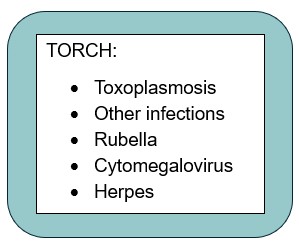
“About 5 percent of pregnant women in industrialized nations catch an infectious disease while pregnant. Although most of these illnesses, such as the common cold, seem to have no impact, a few…can cause extensive damage” (Berk, 2014, p. 90). Some of the more commonly known infections that may cause damage to the developing fetus are included within the acronym TORCH, which stands for: Toxoplasmosis, Other infections (such as chickenpox, syphilis and parvovirus), Rubella, Cytomegalovirus, and Herpes. The range of potential consequences will depend in part on the type of infection that has been transmitted to the fetus. Some examples of possible consequences include physical defects, miscarriage, cognitive deficits, prematurity, growth restriction, and even intrauterine death (Ward & Hisley, 2009, p. 181; Berk, 2014, p. 91). Maternal infections can be caused by:
- Bacteria, (such as the sexually transmitted infection syphilis)
- Parasites (such as a malaria infection)
- Viruses (such as chickenpox)
Some potentially harmful infections can be treated during pregnancy or even prior to pregnancy if detected during the pre-pregnancy period. Importantly, there are many ways to reduce the risks to a mother of contracting a number of these infections.
Education (for childbearing-aged people, their social support networks and society as a whole) about the various factors known to cause or increase the risk of harm during prenatal development can provide additional support for healthier prenatal development and improvements to long term outcomes in the next generation.
References
Berk, L. E. (2014). Development through the lifespan (6th ed.). Pearson.
Gale encyclopedia of medicine. (2008). Teratogen. Gale encyclopedia of medicine. https://medical-dictionary.thefreedictionary.com/teratogen
Ward, S. L., & Hisley, S. M. (2009). Maternal-child nursing care: Optimizing outcomes for mothers, children, and families. F.A. Davis Co.
World Health Organization. (2015). Congenital anomalies: Fact sheet.
https://www.who.int/en/news-room/fact-sheets/detail/congenital-anomalies

