Human Sexual Determination and Differentiation
Emis Akbari, Ph.D.
Atkinson Centre for Society and Child Development, University of Toronto
Sexual determination and differentiation is a complex process that involves a series of precise events that occur at developmentally critical periods throughout gestation involving both genetic and hormonal influences that result in the observed sexual dimorphism that is present at birth.
Sexual Determination – Genetic Sex
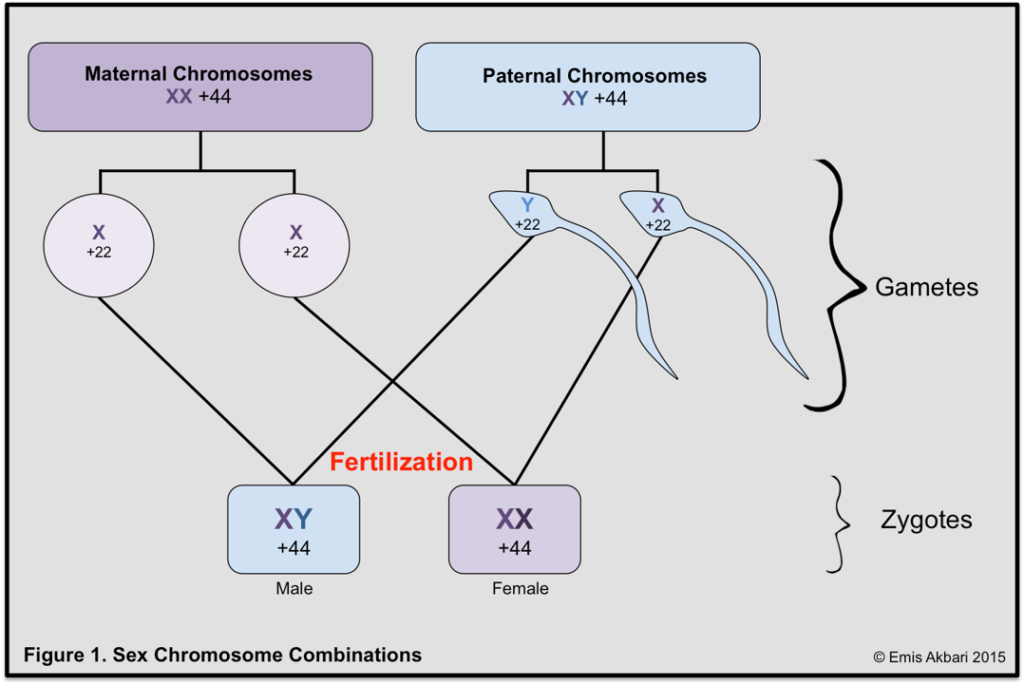
Each human being possesses 46 chromosomes that are organized in 23 pairs. One of each pair is inherited from the father, while the other is inherited from the mother. These 46 chromosomes exist in every cell in the body, with the exception of gametes (ovum and sperm). The ova and sperm each only contain 23 chromosomes, so that when they merge at conception, the new zygote will have 46 chromosomes. Of our 23 pairs of chromosomes, 22 are called autosomes. The 23rd pair is called allosomes (or sex chromosomes) and determines the sex of the new zygote. In females, the 23rd pair is comprised of two large X-shaped chromosomes and is therefore referred to as XX. In males, the 23rd pair is comprised of one large X-shaped chromosome and one small Y-shaped chromosome and is specified as XY. Consequently, every ovum in a female’s body will always possess an X-chromosome. Conversely, in males, because the 23rd pair is XY, each sperm will either contain an X or a Y chromosome. Hence, at the point of conception, a couple can usually produce two possible combinations (see Figure 1). Ultimately, it is the presence of these sex chromosomes that stimulate the development and subsequent differentiation of the primordial (undifferentiated) gonad. The subsequent process of sexual differentiation results from the presence or absence of male-typical androgens and Anti-Müllerian Hormone (AMH) that is produced from the fetal testes. Therefore, the role of the Y chromosome in the differentiation of males is critical, with female differentiation arising in the absence of male genetic and hormonal factors. Hence, female sexual differentiation is often referred to as the default sex.
Sexual Differentiation
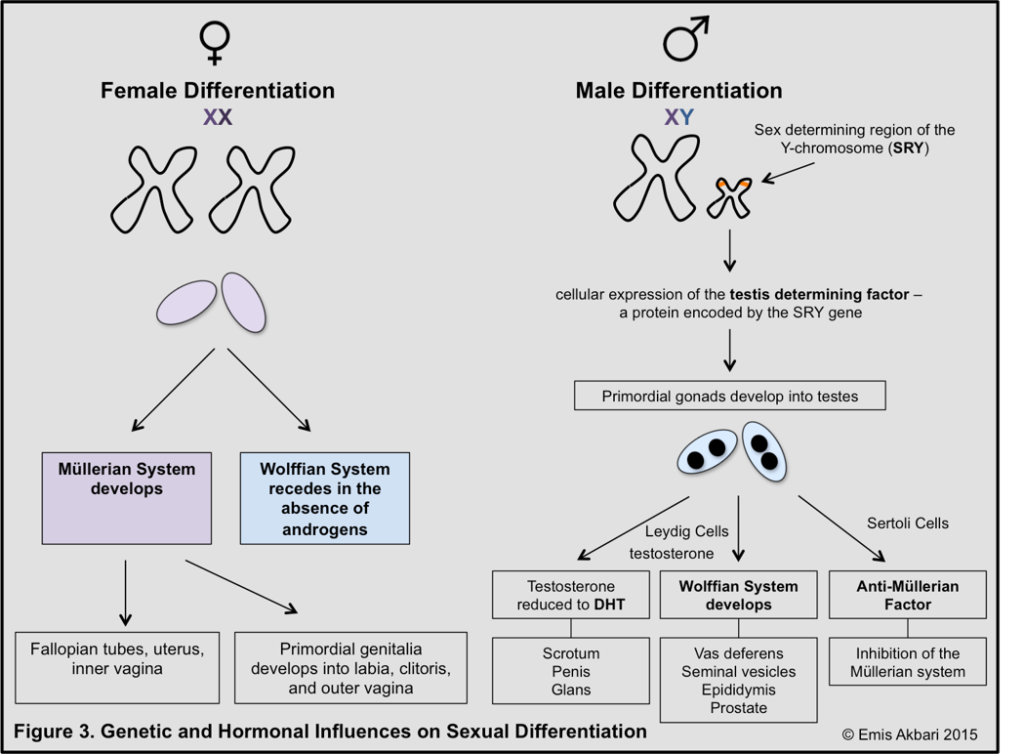
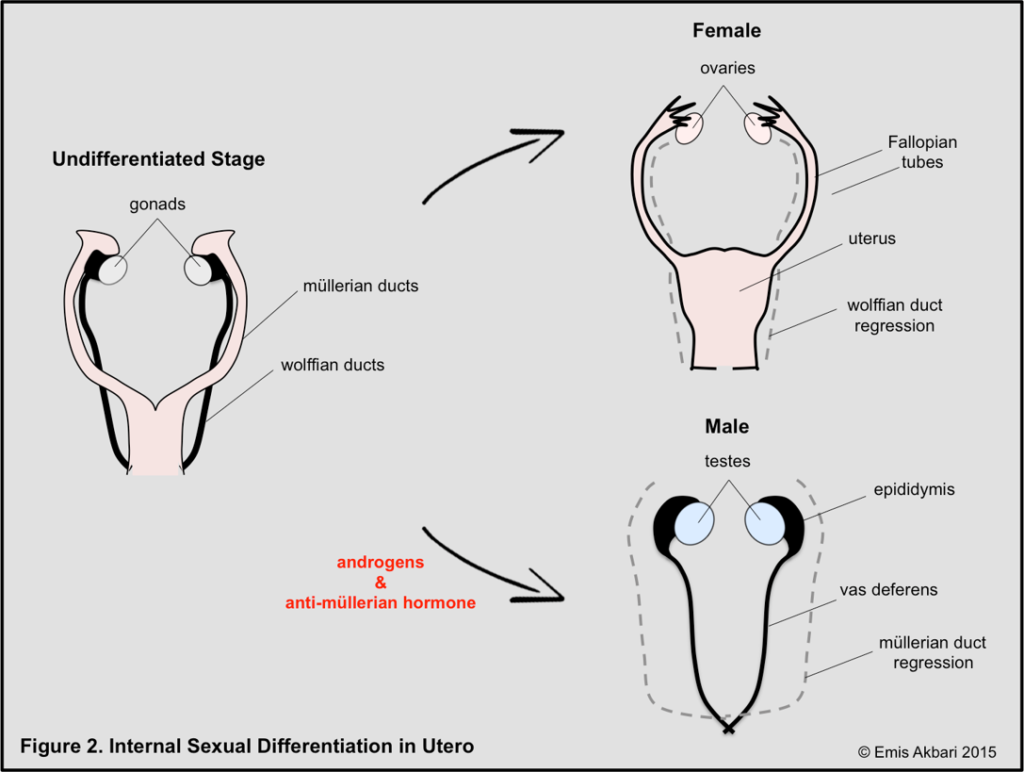
During development each individual has a thickened ridge of tissue on the ventral surface of the proto (primitive) kidney. At this stage this primordial gonad is undifferentiated. Each individual has two systems present early in development: 1) the Müllerian System (female-typical); and 2) the Wolffian System (male-typical). Whether the primordial gonads develop into ovaries or testes is determined by the cellular expression of the testis determining factor (TDF), a protein encoded by the SRY gene (Sex-determining region of the Y-chromosome). The TDF triggers the differentiation of the primordial gonads into testes (see Figure 2). Cells within the testes (Sertoli cells) begin to secrete AMH, which results in the regression of the Müllerian Ducts. Other cells within the testes (Leydig cells) begin to produce androgens (testosterone). The development of the Wolffian ducts into male gonads is dependent on the presence of androgens and therefore begins to differentiate into male reproductive parts such as the vas deferens, the seminal vesicles, the epididymis, and the prostate. Testosterone is reduced to 5 a-dihydrotestosterone (DHT) and stimulates the development of the external genitalia including the penis, the glans, and the scrotum. This is an active process.
In females, with the absence of the Y-chromosome, and likewise the SRY gene, the primordial gonads develop into a female-typical system. In the absence of androgens and the AMH, the Wolffiansystem regresses and the Müllerian system develops into the uterus, the fallopian tubes, the vagina, and clitoris (see Figure 3). This is a passive process.
Since every individual possesses both systems early in development, it is entirely possible to develop both male- and female-typical features. In conditions where there is an absence of androgens, an inability to detect androgens, or deficits the production of the AMH, genetic males (XY) at birth can be typed as a female. In these cases, the androgen dependent Wolffian system does not develop and/or the Müllerian system does not regress. Conversely, in conditions with increased androgen release, genetic females (XX) at birth may be typed as male or show masculinization of genitalia, with both the Müllerian systems (no AMH) and the androgen dependent Wolffian systems developing (with increased androgens).