
Nhodo and Mancala
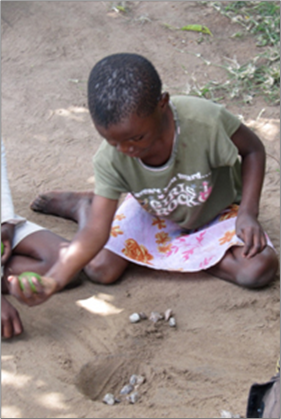
Nhodo is a numbers game played by girls in the age range of about five to 13 years old living in Zimbabwe. The girls sit cross-legged round a hole in the ground. (Today they can draw a circle on a cement floor since it is impossible to make a hole.) When they play the game, they can use small stones or fruit seeds as play implements. One bigger stone or seed is used as the mudodo that is not allowed to hit the ground as it is thrown up and is caught. As the mudodo is thrown up, the same hand removes and returns the other stones from a small hole in front of the players, who sit around it and wait to take their turn in the event that other one in the round fails. There are several types of Nhodo, but all involve the mudodo and stones/seeds of fruits. One type involves throwing the mudodo and picking the other stones one by one or two by two and so on. Scoring is when the player successfully picks stones without dropping the mudodo. If one misses picking and in the process drops the mudodo, she passes the chance to the next player who also tries to win the round without dropping the mudodo.
When this game was analyzed as an Indigenous way of knowing, researchers found it teaches numeracy. Each player is taught to count since as each picks the stones, she must pick the stones singly, in twos or in higher numbers. This shows that the player learns to count in an orderly ascending manner.
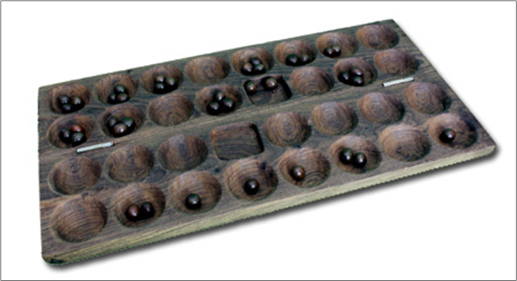
Mancala is a family of board games played around the world, sometimes called “sowing” games or “count-and-capture” games, which describes how the game is played. The Mancala games share a common general game play sequence. Players begin by placing a certain number of seeds, prescribed by the game variation in use, in each of the pits on the game board. A player may count their stones to plot the game. A turn consists of removing all seeds from a pit, sowing the seeds (placing one in each of the following pits in sequence), and capturing based on the state of board.
Mancala may well be the oldest board game in the world and it can be easily played with whatever medium happens to be around. People often play with pebbles using hollows scooped into the earth or with seashells in rings in the sand or specially carved wooden board with seeds. The game of Bao is a popular East-African variant of Mancala.
Researchers who study young children who have been introduced to a simplified version of Mancala find that the children use counting skills and simple logic strategies to play the game. Playing Mancala reinforces informal mathematical understanding and can provide a bridge to acquiring and using a formal number system.
Excerpt from:
Nyota, S. & Mapara, J. (2008). Shona Traditional Children’s Games and Play: Songs as Indigenous Ways of Knowing. The Journal of Pan African Studies, vol.2, no.4, June 2008 189 – 202.

