
Critical and sensitive periods of development
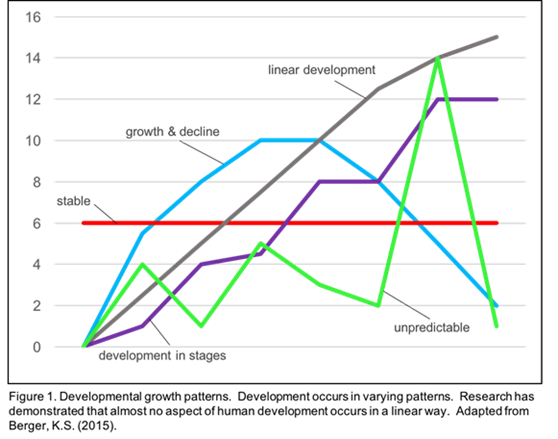
The effects of time are at the centre of the study of human development. Early ideas of human development were that we gradually progress and develop until early adulthood (approximately age 18), plateau, and then begin to decline. We now know that development is not linear (see Figure 1). Development occurs quickly, slowly, and at times there is no change. Stability within itself is astonishing. Regardless of the type and rate of change of development, one central aspect is age.
Critical Periods
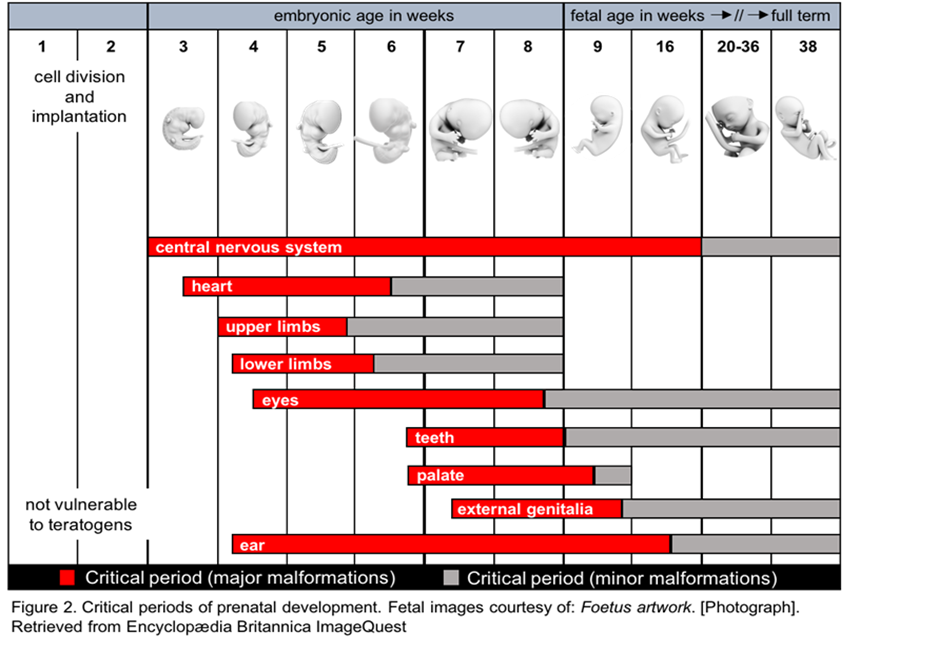
Several changes that occur during development are abrupt and rapid. These are defined as critical periods, a period of time in development when a specific growth must occur for normal development to take place. For example, the critical period for humans to develop limbs is between 38 and 50 days of gestational age. Following this critical period, development of limbs is not possible. In the late 1950s and early 1960s, women were prescribed thalidomide to treat the effects of pregnancy-related nausea. The drug disrupted fetal development. If taken between days 38 and 50 of gestation, when the fetus’ limbs were developing, malformations or complete absence of limb formation resulted (Moore & Persaud, 2007). If thalidomide was taken after the 50th day of gestation, normal limb development was seen.
Sensitive Periods
Although critical periods see immense changes in development, there are only a few critical periods for development. Most often, development occurs more gradually. Sensitive periods are times when a type of development is more likely to occur. These types of development can still occur outside the sensitive period, but happen with more difficulty (e.g., development of language; Moore & Persaud, 2007).
Figure 2 illustrates critical periods of development during pregnancy. These periods are either more (red) or less (grey) vulnerable to teratogens (an agent that causes embryonic malformations).
Brain development
Nelson et al (2019), in a discussion about early brain development, write that while the terms critical periods and sensitive periods are often used interchangeably and both refer to “time windows” during which experiences can have a particularly strong impact on neural development, there are in fact distinct differences between the two terms. “Critical periods are a special class of sensitive periods that result in irreversible changes in brain function. The identification of critical periods is of particular importance to clinicians, because the adverse effects of atypical experience throughout a critical period cannot be remediated by restoring typical experience later in life” (Knudsen, 2004, p. 1412).
References
Berger, K.S. (2015). The developing person: Through childhood and adolescence (10th ed.). Worth Publishers.
Moore, K.L., & Persaud, T.V.N. (2007). The developing human: Clinically oriented embryology (8th ed.). Saunders.
Knudsen, E. I. (2004). Sensitive periods in the development of the brain and behavior. Journal of Cognitive Neuroscience, 16(8), 1412-1425. https://10.1162/0898929042304796Bottom of Form
Nelson, C. A., Zeanah, C. H., & Fox, N. A. (2019). How early experience shapes human development: The case of psychosocial deprivation. Neural Plasticity. https://www.ncbi.nlm.nih.gov/pmc/articles/PMC6350537/

