
Carolina Abecedarian Project
Campbell et. al. (2001) explain that in the 1970s, the Carolina Abecedarian Project identified over 100 infants who were born into extreme poverty. Shortly after birth, the babies were randomly assigned either to the early intervention (treatment) group or a control group. Between 3 weeks and 3 months of age, infants in the early intervention group were enrolled in a high quality, full-time child care program. They attended the program until they entered kindergarten in the public school system. The control group received no special early childhood programming or resources. Both groups received the same nutrition and health services. During the first 3 years, the children in the early intervention group received enriched programming aimed at promoting optimal development. After age 3, emerging and early literacy and numeracy activities were added to the programming. At all ages, the program emphasized adult-child interactions. Qualified early childhood teachers were trained to be informative and nondirective. Children were read to and engaged in daily conversations with the staff.
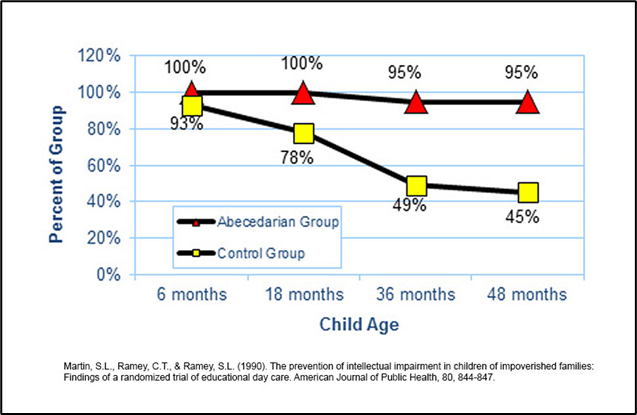
The researchers collected measures of children’s development, particularly measures that tested their cognitive development and IQ. By 12 months they found that the performance of the two groups began to diverge. The children in the child care centre scored higher than the children in the control group. This pattern continued throughout the preschool period (Martin et al., 1990). Figure 1 shows the percentage of children in the Abecedarian group and control group who scored 85 or higher on IQ tests at 6 months, 18 months, 36 months, and 48 months.
Campbell et. al. (2002) explain that the children in the treatment group continued to receive benefits from their participation in the early childhood program throughout their school years and into early adulthood. The children who participated in the Abecedarian intervention had:
- Significantly higher achievement scores in reading and math at ages 8, 12, 15, and 21 years.
- A lower rate of grade retention (i.e., failing at least 1 grade) that was almost half the rate for the control group.
- A lower rate of placement in special education by age 15 (12% of the treatment group vs. 48% of the control group).
Campbell et. al. (2012) describe a follow up done when 101 of the original 111 participants were 30 years old. The researchers looked at educational, economic and social-emotional adjustment outcomes. The educational benefits associated with the intervention were still strong. Individuals in the treatment group had successfully completed more years of education. Abecedarian Project participants were more likely to have been consistently employed and less likely to have used public assistance. They also showed a tendency to delay parenthood by almost two years compared to the control group. Project participants appeared to have done better in relation to several other social and economic measures (including higher incomes), but those results were not statistically significant. There were no differences in criminal involvement between the participants in the program and the control group.
Numerous follow-up studies in the United States, Canada, Australia, Romania, India, Pakistan, and Zimbabwe have generated similar results. Since the original study, the Abecedarian Approach has been used successfully in center-based care, home visiting programs, family day homes, and public school pre-K settings (AEF Global, 2019).
References
AEF Global. (2019). Abecedarian Education Foundation Research. https://www.aefglobal.org/research
Campbell, F., Pungello, E., Burchinal, M., Kainz, K., Pan, Y., Wasik, B., Barbarin, O., Sparling, J., & Ramey, C. T. (2012). Adult outcomes as a function of an early childhood educational program: An Abecedarian Project. Developmental Psychology, 48(4), 1033-1043. https://www.ncbi.nlm.nih.gov/pmc/articles/PMC3989926/pdf/nihms570539.pdf
Campbell, F., Pungello, E., Miller-Johnson, S., Burchinal, M., & Ramey, C. (2001). An early childhood educational experiment. Developmental Psychology, 37(2), 231-242.
Campbell, F. A., Ramey, C. T., Pungello, E., Sparling, J., & Miller-Johnson, S. (2002). Early childhood education: Young adult outcomes from the Abecedarian Project. Applied Developmental Science, 6(1), 42-57. https://doi.org/10.1207/S1532480XADS0601_05
Martin, S.L, Ramey, C.T, & Ramey, S.L. (1990). The prevention of intellectual impairment in children of impoverished families; Findings of a randomized trial of educational day care. American Journal of Public Health, 80(7), 844-847. https://www.ncbi.nlm.nih.gov/pmc/articles/PMC1404993/

