
Reading for Children 2007 - 2015
AGA KHAN DEVELOPMENT NETWORK
www.akdn.org
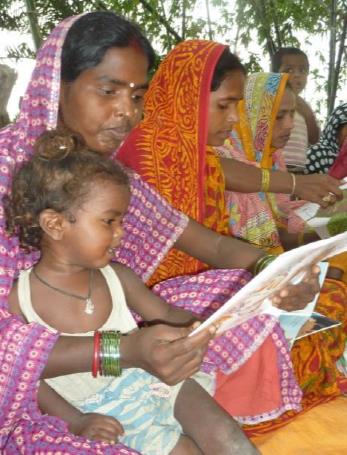
Reading for Children (RfC) was first implemented by the Aga Khan Foundation Kyrgyzstan in 2007. The programme has grown from a little pilot in Kyrgyzstan to an essential component of AKDN’s Early Childhood Development (ECD) portfolio in 15 countries. Nearly 100’000 children (2-12 years) and over 65’000 parents/caregivers borrowed books in 2014. To date, over 800 mini-libraries have been established in ECD centres or schools, people’s homes, places of worship, or as part of groups such as Community-Based Savings Groups or horticulture groups. AKDN is also exploring the establishment of mini-libraries within and around AKDN-owned companies such as Ivoire Coton in Côte d’Ivoire and the Serena Hotels in Kenya, Uganda and Tanzania.
| Central & South Asia | East and West Africa | Middle East | Europe |
|---|---|---|---|
| Afghanistan | Côte d’Ivoire | Egypt | Portugal |
| Bangladesh | Kenya | Syria | |
| India | Mali | ||
| Kyrgyzstan | Uganda | ||
| Pakistan | Tanzania | ||
| Russia | |||
| Tajikistan |
Implementation strategies
One of the strengths of Reading for Children is its flexibility. Mini-libraries can be integrated within/linked with:
- ECD and educational facilities such as ECD centres/pre-schools, schools, youth and adult literacy centres
- Children’s organizations such as children’s clubs, youth groups
- Places of business such as hotels and factories
- Health centres or clinics
- Places of worship
- Village organisations/community groups such as community savings/credit, horticulture
Outcomes for children and parents/caregivers
AKDN uses ongoing monitoring data, anecdotal evidence as well as internally and externally conducted studies to document the numerous benefits Reading for Children has on children and parents/caregivers.
Across all countries we have seen:
- Increased access to age-appropriate books
- Increased parental awareness about the importance of reading to/with children
- Increased confidence and interest among parents/caregivers in their abilities to support their children’s learning
- Improved parent-child relationships
- Numerous observations from ECD and primary school teachers that children are ‘doing better’ than those who do not participate in the programme
- Reading becomes a regular family activity and in urban areas a replacement for watching television or playing video games.
Country-specific outcomes include:
| East Africa | – Primary schools linked with community libraries resulted in stronger results for children’s literacy scores and parental engagement compared with schools not linked to any library. |
| Mali | – Fathers now ‘breaking tradition’ and reading and engaging with their children. – Parents listening to their children, understanding and interacting more. |
| Portugal | – Weekly parenting programme with strong early language/literacy elements showed positive outcomes for children and parent’s confidence and interest. |
| India | – In Gujarat, reading now regular activity in homes. – In Bihar, grandparents narrating folks stories more often. – In Bihar, illiterate women request literacy classes so they read more with their children. |
| Kyrgyzstan | – Children who participate in RfC and a centre-based ECD programme have a double advantage. Grade 1 reading achievement scores for these children exceed those who had only benefited from one or the other but not both. – Benefits of participating in RfC still visible in Grade 4. – National Award for AKF Children’s Books. |
| Tajikistan | – Positive improvement in how much time is spent reading to/with children and update of reading practices which promote enjoyable experiences. – Grade 1 language outcomes are higher for children who participate in RfC versus those who do not (79% vs. 65%). |
What is Reading for Children?
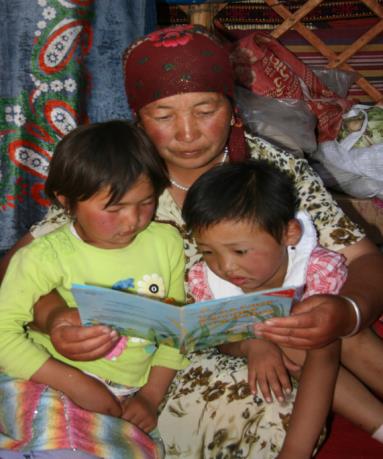
The Reading for Children programme responds to the fact that being read to as a child is one of the strongest predictors of later academic success. All over the world, too many children leave primary school unable to read and write fluently. What happens in school is important, but if we wait to tackle the problem until children are in school it is too late. Children who have been read to before they go to school, and whose family members continue to read to them, are shown to outperform those who have not had such opportunities. Reading at home also reinforces positive relationships within the family. Reading for pleasure helps to develop children’s language, literacy, critical thinking, communication, social and emotional skills. Quite simply being read to from an early age helps children become confident learners.
A number of factors prevent parents/caregivers from being able to read to children. These include:
- Lack of easily available, affordable illustrated storybooks – especially in relevant local languages – in schools, homes and communities
- Family illiteracy and/or limited literacy skills
- Families underestimating the significance of their role in supporting children’s language, learning and sense of themselves.
- Heavy workloads and lack of time
The Reading for Children programme addresses these challenges by:
- Establishing mini-libraries – which can sometimes operate out of a tin trunk, wooden box or bag – and enabling parents/caregivers/caregivers and siblings to borrow simple, illustrated storybooks to read to young children.
- Workshops for parents/caregivers/other family members which build their skills and confidence in interacting with their children, telling stories and making reading with their children an enjoyable experience.
Additional features applicable to some countries:
- Development of children’s books working with local communities, authors and illustrators. Stories may be based on local traditions or newly developed stories.
- Television shows and mobile apps
- Reading festivals, puppet shows
The objectives of the Reading for Children programme are to:
- Provide access to books
- Ensure opportunities for young children to be introduced to storybooks and have enjoyable interactions with their families
- Strengthen parents/caregivers’/caregivers’ confidence in their abilities to support their children’s development and learning
- Develop children’s readiness for reading and school
- Reinforce emerging literacy skills in primary school students
- Sustain and develop literacy skills among adults with limited literacy skills/opportunities.
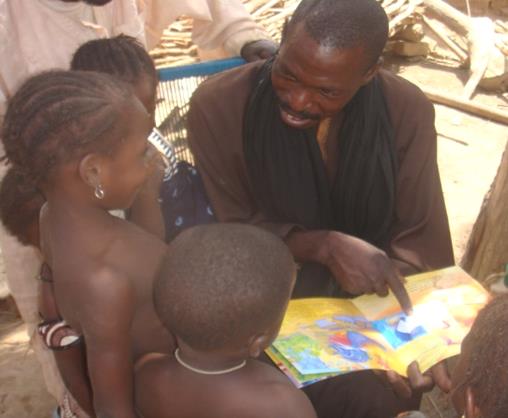
Reading for Children is simple, flexible, and beneficial for the entire family. RfC was originally part of early childhood initiatives. Very early on, the communities began to notice the benefits for older children and themselves. The libraries are now more widely used by older children and adults to reinforce their own literacy skills. Adults, particularly mothers and grandmothers, are demanding literacy classes. Older siblings are often seen reading with younger children, being read to by a parent/caregiver/, and reading alone. RfC is transforming how family members interact with each other, is developing a thirst for books and learning, and nurturing a culture of reading.
Reading for Children is affordable, flexible, doable, scalable and has multiple benefits for children as well as parents/caregivers.

